
AI dinner apps
AI Recipe Generators and AI Dinner Deciders Are Not the Same Product
Search the App Store for an AI recipe generator and you get two kinds of app wearing the same words. One writes you a recipe when you tell it what you want. The other tells you what to want. They get reviewed against each other constantly, as if they compete, and a lot of people install the first one while carrying the second one's problem. Here is how to tell which you are shopping for.
What is an AI recipe generator app, and is it what you actually want?
A recipe generator takes a request, ingredients or a craving or a macro target, and writes a new recipe around it. It is a writing tool. It is the right buy when you know what you want and need the method. It is the wrong buy when the thing you cannot do is pick.
The distinction sounds academic until you are standing in the kitchen at six. A generator has an empty box in it, and an empty box is a question, not an answer. Filling it takes the one thing that has already run out by then, which is the willingness to specify. You have to decide on a protein, a mood, a cuisine and an effort level just to write a prompt worth submitting, and by the time you have decided all of that, you have basically decided dinner. The AI is doing the part you could already do.
That is why the generator category and the decider category feel identical in a listicle and completely different at the stove. We ranked the actual apps in the best AI recipe app in 2026. This post is about the layer underneath that ranking: which of the two products your evening actually needs.
What does a generator ask of you that a decider does not?
A specification. A generator needs an input that describes the dish you want, so the quality of what comes back is capped by how well you already knew. A decider takes constraints instead: what you do not eat, how little time you have, what you had last night. It works from what you can rule out.
This is the whole difference, and it is worth sitting with. Specifying is generative work. Ruling out is elimination work. They feel nothing alike when you are tired, and the second one is what people are actually capable of at the end of a day. Almost nobody can produce "Korean-ish braised short ribs, one pot, ninety minutes" on demand. Almost everybody can say "not chicken again" and "nothing that takes an hour."
| AI recipe generator | AI dinner decider | |
|---|---|---|
| What you give it | A request describing the dish | Constraints, plus whatever it already knows about you |
| What comes back | A recipe, or a stream of them | A short set of dinners chosen for tonight |
| What it remembers | Usually nothing between sessions | Ratings, cooked meals, standing rules |
| What "good" means | Novel and plausible | Something you will actually make tonight |
| How it fails | Hands you more options and no decision | Narrows too soon, or narrows around a stale idea of you |
| Best night for it | You know the dish and want a method | You know nothing except that people are hungry |
Notice that the failure modes are not the same failure in different clothes. A generator fails by abundance, which is the exact mechanism behind dinner decision fatigue: past a certain number of options, each new one costs you rather than helps. A decider fails by conviction, when it commits to a pick that is wrong for tonight. Those two failures need opposite fixes, which is why one product cannot be tuned into the other.
Can you trust a recipe nobody has cooked yet?
Treat it as a draft. A generated recipe was assembled from patterns, not tested in a kitchen, so nobody has ever confirmed the bake time or the salt. That is true of every AI recipe, ours included. It is fine for most weeknight cooking and it is worth a glance before you commit.
We would rather say this plainly than let it be a surprise. When a recipe comes off a blog, some human made it at least once, badly photographed it, and heard from commenters when the timing was off. A generated recipe skips all of that. It is usually right, because weeknight cooking is not exotic and the patterns are strong, and when it is wrong it tends to be wrong in three predictable places.
- Ratios in anything that sets or rises. Baking is chemistry with a narrow tolerance. If a generated recipe involves leavening, check the amount against a recipe you already trust before you commit an hour to it.
- Times stated for equipment it cannot see. It does not know your oven runs hot or that your skillet is thin, so read the time as an estimate and the visual cue as the instruction.
- Meat temperatures. Cook to a thermometer, not to a paragraph. The USDA safe minimum internal temperatures are 165F for poultry, 160F for ground meats, and 145F with a three minute rest for whole cuts of beef, pork, lamb and veal, and for fish. If any recipe, AI written or not, contradicts those, the recipe is wrong.
Allergies deserve their own line, because this is where "usually right" is not good enough. A generator will honor an allergy you mention in the prompt for exactly as long as that chat lasts. Anything that matters medically should be a setting the app enforces every single time, not a sentence you have to remember to retype, which is the argument we made in no mushrooms and I can't eat mushrooms are different sentences.
What does a decider do with the same request?
It answers with a small set instead of a stream, attaches a reason to each one, and takes your edits as corrections rather than new prompts. Say "lighter" and the same ideas re-form lighter. Nothing restarts, because the app is holding the context you would otherwise be retyping.
RecipePT is ours, so read this as a stated bias and judge the mechanism rather than the enthusiasm. It opens on dinner ideas rather than a prompt box. Each one carries a line explaining why it is there, which reads like "Fits your saved steakhouse flavors without turning dinner into a project", plus the practical tags you would otherwise have to ask for: how long it takes, whether it makes leftovers, whether it is a fresh twist or something familiar.
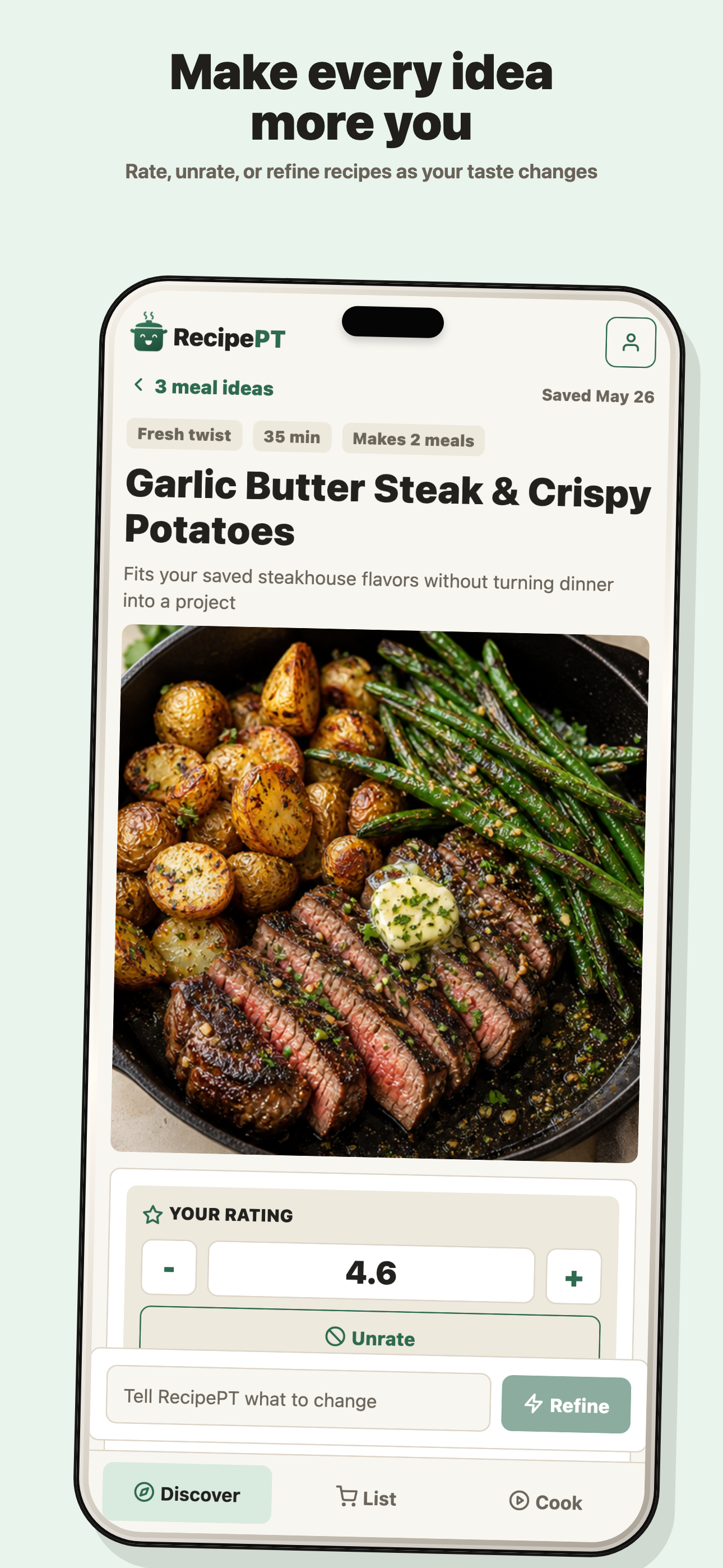
That box is where a decider earns its keep. Type "less spicy" or "no mushrooms" or "more like the last one" and the idea reshapes with everything else held steady. In a generator, the same sentence starts a new generation and you lose the parts that were already right. The most useful thing you can type is a negative, and negatives are precisely what an empty prompt box handles worst, because it has to invent an entire dish around the absence of one ingredient with no memory of what you liked.
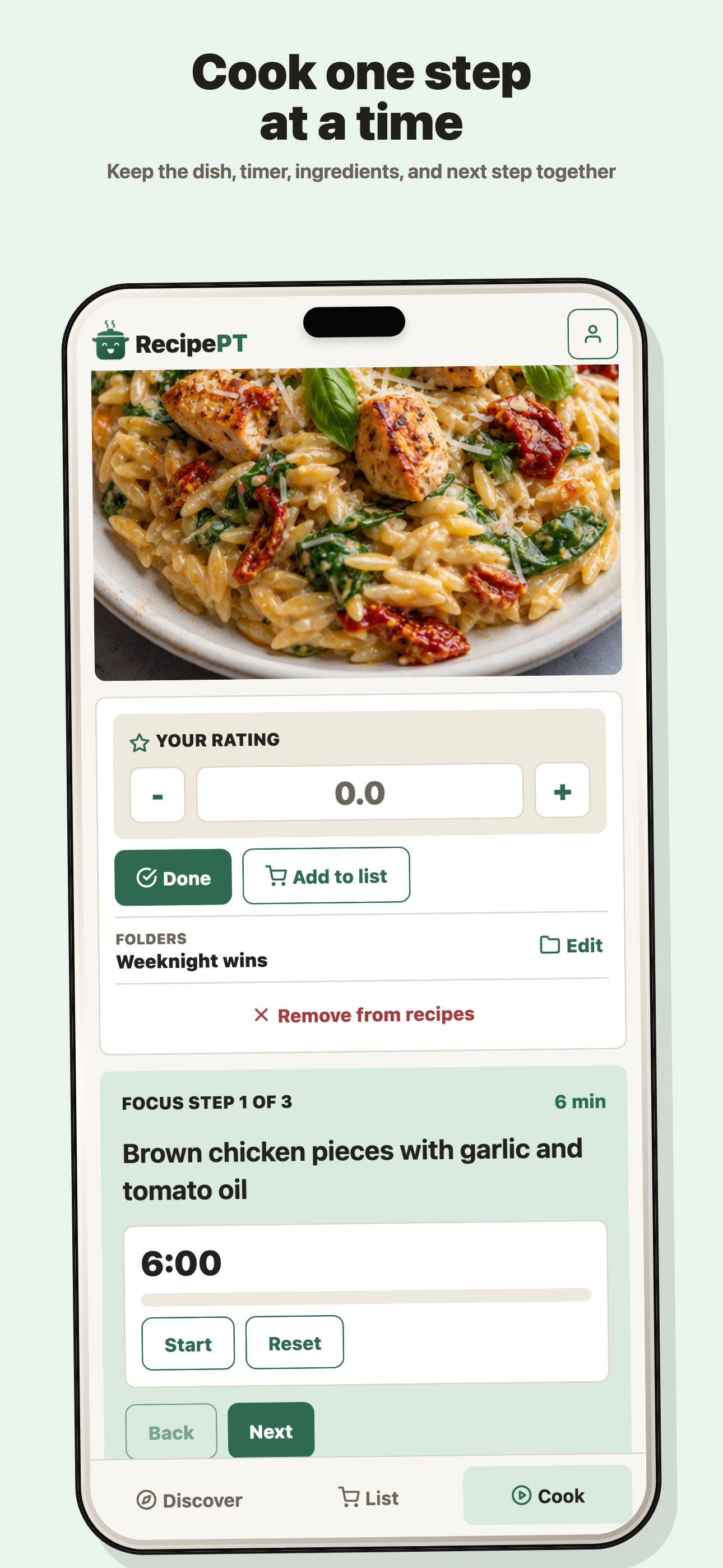
The rating goes back in too. Every dinner you cook and score becomes evidence for the next set, so the app is different tomorrow because of tonight. That is the piece a generator structurally cannot have, and it is the same complaint people have about planning dinner with ChatGPT: brilliant, and amnesiac by design.
Which one should you install tonight?
Answer one question: when you open the app, do you already know what you want to eat? If yes, buy a generator, and DishGen or ChefGPT will serve you well. If the honest answer is no, a generator hands the deciding straight back, and you want something that opens on an answer.
A generator is genuinely the better product for some real situations, and we would rather name them than pretend otherwise. You have one strange ingredient and want ideas nobody has published. You need a dish rewritten around a diet, dairy free or higher protein, and you want the rewrite, not a recommendation. You are cooking for fun on a Saturday and novelty is the point. You want a bottomless source of new material and no interest in an app forming an opinion about you. In all four, being known is not a feature you want, and the pure generators do their job well.
The other case is the Tuesday one. Nothing is planned, there is food in the house, and the thing that has run out is not ideas but the will to choose between them. That is a different product, and buying the wrong one is why so many AI recipe apps get deleted in week two: they answered beautifully, and the question was never the problem. If that is your Tuesday, our guide to apps that cook with what you have covers the adjacent case where the fridge, not the craving, is the starting point.
Let RecipePT decide tonight
Dinner ideas shaped by what you have actually cooked and rated, steered by typing what you want changed. RecipePT holds onto it, so tomorrow starts closer to right.
Get RecipePT on iPhoneCommon questions
What is the difference between an AI recipe generator and an app that decides dinner?
A generator turns a request into a recipe, so you have to know what you want before it is useful. A decider takes constraints instead of a request, narrows to a small set for tonight, and carries what it learned into tomorrow. One produces text, the other ends a question.
Is there an AI app that generates recipes from the ingredients I already have?
Yes, several. DishGen and ChefGPT both take an ingredient list and write recipes around it, and SuperCook does the same job by search rather than AI. The catch is that they return possibilities rather than a pick, so the choosing is still yours. If the choosing is the part that stalls you, a generator makes the pile bigger, not smaller.
Are AI-generated recipes reliable enough to cook?
Treat any AI-written recipe as a draft rather than a tested one, including ours. Nobody cooked it before it reached you, so check the parts that fail loudly: leavening amounts, bake times, and any temperature involving meat. The USDA safe minimum internal temperatures are 165F for poultry, 160F for ground meats, and 145F with a three minute rest for whole cuts of beef, pork, lamb and veal, and for fish. Judge doneness by those, not by the number in the recipe.