
AI dinner apps
The Best AI Recipe App in 2026: An Honest, Tested Ranking

Quick answer: Match the app to the job. To decide what to cook tonight, RecipePT, which is ours, so treat that as a stated bias. For endless recipe generation on a budget, DishGen's free tier. For saving recipes with an AI helper, FoodiePrep. SuperCook is rule-based search, not AI, and Yummly shut down.
Search the App Store for "AI recipe" and you get a wall of apps that look different and do the same thing: you type a request, the AI writes back a recipe. That is genuinely useful, but it is one job, and it is not the job most people mean when they are standing in the kitchen at 6pm. So the real question is not which app has the smartest AI. It is what you want the AI to actually do.
What is the best AI recipe app in 2026?
It depends on the job. To decide what to cook tonight, RecipePT gives three personalized ideas you refine by typing (ours, so a stated bias). For endless recipe generation on a budget, DishGen has a free tier. For saving recipes with an AI helper, FoodiePrep. "Best" hinges on whether you want the AI to generate, remember, or decide.
What separates these apps is not who has the better model. It is what the AI is pointed at. "Tested" here means one thing: every app ran the same three-question rubric below, scored against its current listing and, for the app we make, hands-on daily use. It is not a lab benchmark. One honesty note before the ranking: if a list still tells you to download Yummly for this, close the tab. Whirlpool shut Yummly down, and as of this writing yummly.com redirects to KitchenAid's recipe site. A lot of "best AI recipe app" posts are quietly out of date.
Why do most AI recipe apps feel the same?
Because most of them are the same job in different packaging: type a request, get a recipe. That is a generator. It is great for novelty, but it hands the deciding right back to you. You still have to know what to ask for, then choose from what it returns. The AI writes; you decide.
It helps to see that "AI recipe app" actually splits into three different jobs, and almost every app is strong at one of them:
- Generate. Turn a prompt or an ingredient list into a brand-new recipe. This is what ChefGPT and DishGen do.
- Match. Find existing recipes you can make from what is in your kitchen. This is SuperCook, and it is really search, not AI.
- Decide. Narrow the whole thing to a small pick for tonight and remember you next time. This is the job RecipePT is built for.
A generator that returns fifteen possibilities has not solved the problem we wrote about in why dinner decision fatigue happens. It has just moved the pile. That is the lens for the ranking: not how clever the AI sounds, but how close it gets you to one dinner you will actually make. Our founder pulled apart the architecture underneath that split, why the category was built as a keyword filter and what language models actually changed, in Every Recipe App Is Still Just a Filter.
How do the 5 AI recipe apps rank, and how did we judge them?
Each app ran the same three tests. Does it truly generate, or just search a fixed database? Does it remember you between sessions, or start blank? Does it decide, narrowing to a pick, or hand you infinite prompts? Ranked from least to most decisive. Facts come from each app's App Store listing or site, checked July 27, 2026.
5. SuperCook, the free ingredient search that is not really AI
SuperCook advertises over 11 million recipes from thousands of sites, and it is the best free way to answer "what can I make with what I have." You tick off ingredients, it lists everything you could cook. But it is rule-based matching, not AI: it ranks by fewest missing ingredients, not by what you would actually want, and it stops at a list, often a long one. Pick it if you want a free ingredient search and you do not mind doing the choosing yourself. We compared it in depth in SuperCook vs RecipePT.
4. ChefGPT, the generator that drifted into tracking
ChefGPT is a capable AI recipe generator with named modes: PantryChef builds from ingredients you have, MasterChef takes any request, MacrosChef hits macro targets, MealPlanChef assembles a week. It runs on iPhone and Android. Worth knowing before you tap install: it has expanded well past recipes, and its App Store listing now leads as a calorie tracker. Pick it if you want recipe generation and calorie logging in one app. If you only want dinner ideas, the extra machinery is weight you are not using.
3. DishGen, the cleanest pure generator
If you want the generator job done well and nothing else, DishGen is the honest pick. Describe an idea or list your ingredients and it generates all-new recipes and meal plans on demand, on iPhone and Android. The Basic plan is free forever with 15 recipe credits a week; Premium runs $6 a month billed annually and adds a personalized AI model. It is fast and genuinely creative. Pick it if you like driving, you enjoy writing the prompt, and you want a bottomless source of new recipes rather than a decision made for you.
2. FoodiePrep, generation plus a memory
FoodiePrep AI Meal Planner pairs an AI assistant, Chef Foodie, with a recipe saver and weekly planner, so unlike a pure generator it carries something forward: the recipes you save from Instagram, TikTok, or YouTube, plus your stated preferences. It runs on iPhone, iPad, Mac, and Vision, free with a Pro tier at $4.99 and nutrition tiers at $8.99 and $59.99 a year. Pick it if you want AI recipes and a place to keep everything you have already collected. It leans toward organizing, so the deciding is lighter than the generating.
1. RecipePT, which decides instead of generating
This is ours, so treat the top slot as a stated bias and judge the mechanism. RecipePT does not open to a prompt box or a library. You ask, and it returns three dinner ideas for tonight, shaped by what you have rated and cooked, that you then push on in plain language until one is right. It passes all three tests: it generates, it remembers you across sessions, and it narrows to a small pick instead of a scroll. It is iPhone only, and it is a paid subscription with a one-week trial, not a free app.
How does RecipePT decide instead of generate?
It returns three ideas, never a grid or an empty prompt box, then lets you correct them by typing: "no chicken," "lighter," "something the kids will eat." The set re-forms around what you said. Ratings and cooked dinners feed a taste profile, so the three get more like your household over time. Allergies are a hard filter, not a suggestion.
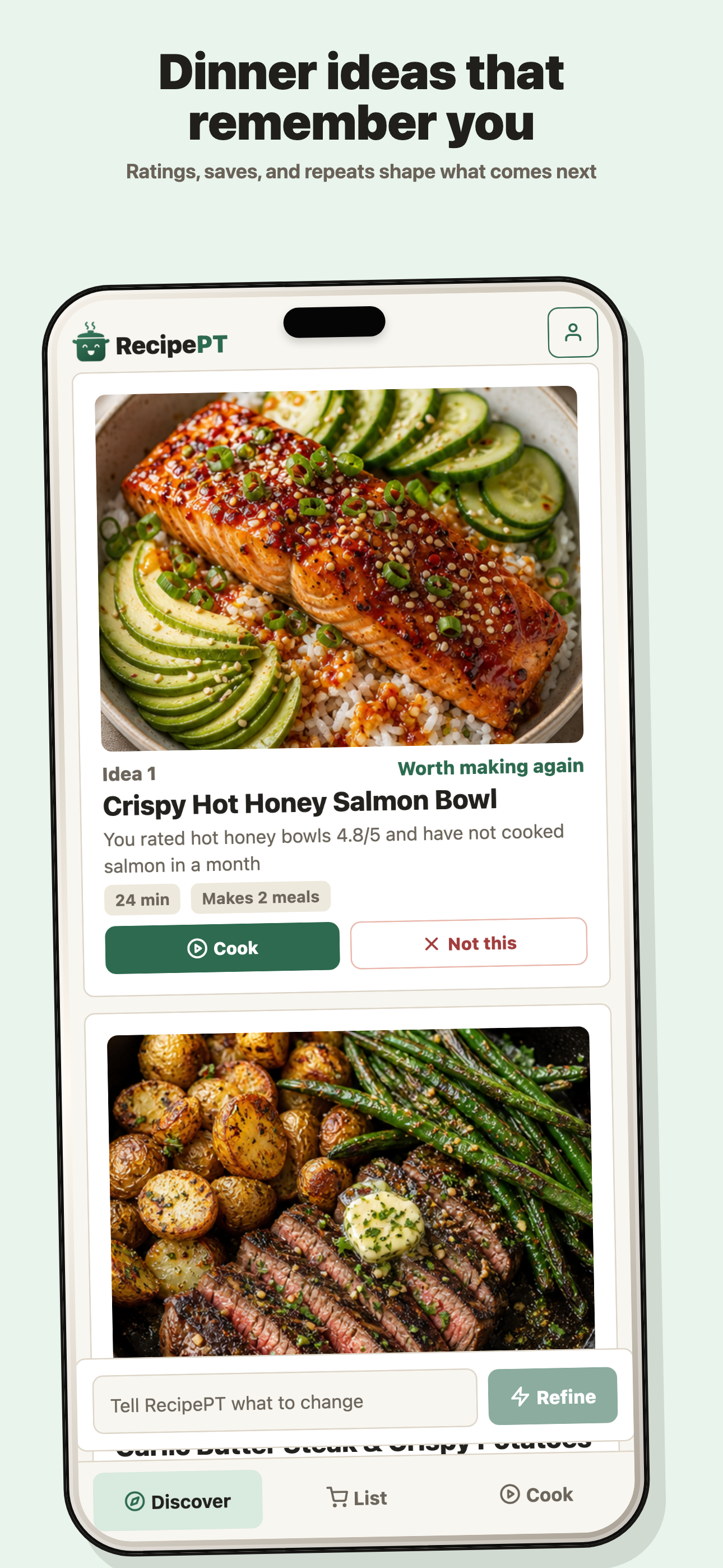
Put the same request through each kind of app and the difference is obvious. Type "chicken, rice, something quick" into a generator and it writes you one recipe to accept or reject, then you prompt again. Ask RecipePT the same thing and it returns three dinners shaped by what you have actually cooked, and "make it a sheet pan" reshapes all three at once instead of starting a new prompt.
Three is deliberate. It is small enough to read in one glance and commit to, and large enough that you are choosing rather than accepting whatever a generator spat out first. The refine step is what keeps it from becoming another dead end, because it works on one idea or all three. If two picks are right and one is wrong, you do not start over: you say "more like the last one", or "make it a sheet pan", or "we had pasta twice this week", and the set re-forms with that held. Negative constraints are the ones that decide real dinners, and they are the ones a prompt box handles worst.
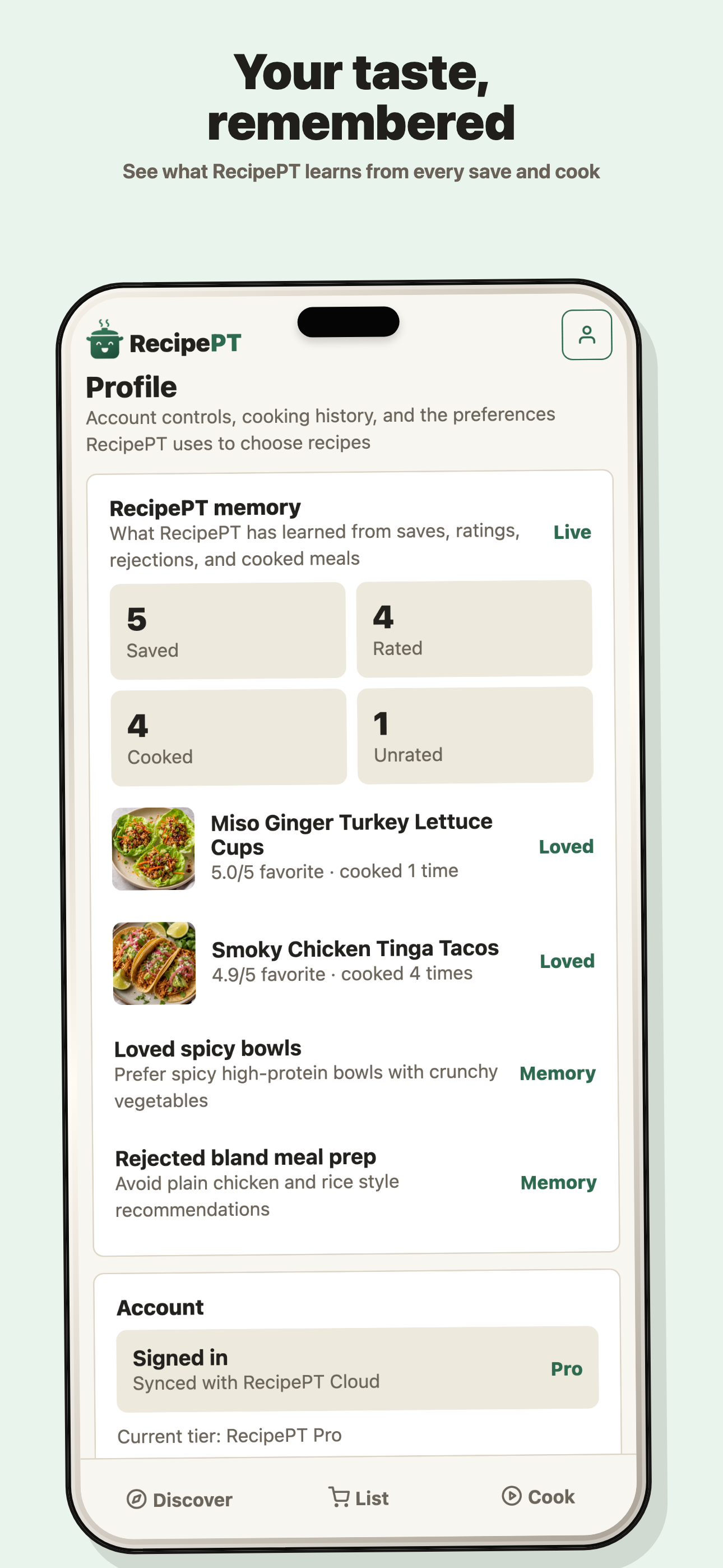
That memory is the whole difference between generating and deciding. A generator is brilliant and amnesiac: every session starts from zero, so you re-supply your preferences each time, which is the same complaint people have about using ChatGPT to plan dinner. Because RecipePT keeps your taste, it can also tell you that you cooked something twelve days ago, usually the fact that settles whether to repeat it, and once you commit it sends the ingredients to a grocery list.
What is the best free AI recipe app?
For pure generation, DishGen's free plan gives you 15 recipes a week. For matching recipes to what you already have, SuperCook is completely free, though it is search rather than AI. RecipePT is a paid subscription with a one-week trial, so it is not the free pick, it is the decide-for-me pick. Match the price to the job you have.
The honest test for any of these, and you can run it in one week, is the same. Does the app ever hand you a dinner you would not have thought to ask for, and does it stop offering the thing you already told it you do not eat? A generator aces the first and cannot do the second, because it forgets. If your problem is a lack of ideas, a free generator like DishGen is plenty. If your problem is the nightly deciding with food already in the house, you want something that remembers you and commits. And if you would rather not install anything at all, the two-minute manual method gets you there without an app.
Let RecipePT decide tonight
Dinner ideas that come from what you have actually cooked, refined by typing what you want, with a grocery list on the other side. On iPhone, with a one-week trial.
Get RecipePT on iPhoneCommon questions
What is the best AI recipe app in 2026?
It depends on what you want the AI to do. For deciding what to cook tonight, RecipePT gives three personalized ideas you refine by typing. For endless recipe generation on a budget, DishGen has a free weekly tier. For saving recipes with an AI assistant, FoodiePrep. Most AI recipe apps are recipe generators, which is a different job from deciding.
What is the best free AI recipe app?
For pure generation, DishGen's Basic plan is free with 15 recipe credits a week. For matching recipes to ingredients you already have, SuperCook is completely free, though it is rule-based search rather than AI. RecipePT is a paid subscription with a one-week trial, so it is not the free pick, it is the decide-for-me pick.
Is ChatGPT better than a dedicated AI recipe app?
ChatGPT is an excellent recipe generator, but it forgets your preferences between chats, so you re-explain no onions and picky eaters every time. A dedicated app's advantage is memory and structure: it holds your allergies as a hard rule and learns from what you rate and cook, instead of starting blank.
Find something good for dinner.
Browse recipes, search an ingredient, and pick something that fits tonight.
Browse recipes →