What should I cook tonight
How to Decide What to Make for Dinner in Under 2 Minutes (3-Question Method)
Quick answer: Two minutes is enough if you stop searching and start committing. Name tonight's single non-negotiable, take the first option that clears it, then lock the decision instead of reopening it. Under 30 minutes, uses the spinach, the picky kid will eat it: one must-have collapses the field fast.
Most nights you are not missing options. You have a full fridge, a hundred saved recipes, and a phone that will show you ten thousand more. The stall is not "what could I make," it is "which one, and can I please stop thinking about it." This is a method for the second problem: how to actually decide, and make the decision stick, in under two minutes.
How do I decide what to make for dinner fast?
Name the one thing tonight's dinner has to be, take the first option that clears it, and lock the choice so you stop reconsidering. Deciding stalls when you hunt for the best possible meal. Pick the first good-enough one that fits your single non-negotiable, and you are done in under two minutes.
There is an important difference between finding options and choosing one, and almost all dinner advice only helps with the first. If your real problem is a blank slate with too many directions, start by narrowing: we walk through that in what should I make for dinner tonight. This piece is for the other stall, the one where you already have a shortlist in your head or on your screen and still cannot pull the trigger. The tool for that is not more recipes. It is a rule for committing.
What are the 3 questions?
One: what is the single non-negotiable tonight, the one thing dinner must be? Two: what is the first option that clears it, and would I be fine eating that? Three: am I done, or am I reopening a decision I already made? Answer these in order and the choice makes itself.
- What is the one non-negotiable? Not a wishlist, one thing. Under 30 minutes, or it has to use the spinach before it turns, or the picky kid will eat it. Naming a single must-have collapses the field far faster than stacking five preferences you will never fully satisfy at once.
- What is the first option that clears it? Not the best option, the first one you would actually be fine eating. This is the whole trick. The nightly spiral is caused by maximizing, by trying to find the optimal dinner. Satisficing, taking the first good-enough answer, is faster and, honestly, you will enjoy the meal just as much.
- Are you done, or reopening it? Once an option clears the bar, the decision is made. Close the tab. The time people lose to dinner is almost never the first pass, it is the fourth, going back to reconsider a choice that was already fine. Locking it is the step everyone skips.
Watch what that does to a real night. "What's for dinner" is unanswerable. "The first thing I can cook in 30 minutes that uses the ground beef, and I am not allowed to reconsider it" is basically already decided.
How does the decision tree help when I still can't commit?
When you have a shortlist but still cannot pick, break the tie on energy, not flavor. No energy, assemble a no-cook plate and stop. A little, keep it to one pan and a 20-minute cap. Genuinely want to cook, make the first idea that clears your non-negotiable. Still stuck after two minutes? Make your fallback. Deciding to default is still deciding.
- No energy at all → do not cook. Assemble. A no-heat plate of things you already have counts as dinner, and it removes cooking from the decision entirely.
- A little energy → one pan or one pot, 20-minute ceiling. The cap itself rules out most of the internet, which is the point.
- Actually up for it → run the 3 questions above and cook the first idea that clears your one non-negotiable.
- Two minutes gone, still stalling → make your fallback, the one meal you can cook half-asleep. Everyone should have one named in advance. Choosing your default on purpose beats letting the clock choose takeout for you.
Why can't I just decide what to eat?
Because you are trying to optimize a small choice at the exact moment your ability to decide is most depleted. Dinner lands at the end of a day of decisions, so the tank is empty right when the question arrives. The problem is not the fridge. It is asking a tired brain to pick the perfect option from an unlimited menu.
Psychologists have a name for the two ways people approach a choice like this. Maximizers try to find the best possible option and feel worse afterward for having agonized. Satisficers take the first option that meets their bar and move on. Dinner is the textbook case where satisficing wins, because the stakes are low, the options are all fine, and the real cost is the deciding itself. We dig into why that end-of-day depletion hits dinner so hard in dinner decision fatigue. The fix in both places is the same: shrink the choice and stop trying to win it.
How RecipePT makes the decision for you
The 3-question method works on paper, but it still leaves you holding the pen. RecipePT runs the same logic for you: instead of a feed to scroll, it hands you three dinner ideas at a time, already shaped by your taste, your time, and what you have. Three is enough to feel like a real choice and few enough to pick from without a spiral. You are satisficing by default, choosing between a few good options rather than auditioning the entire internet.
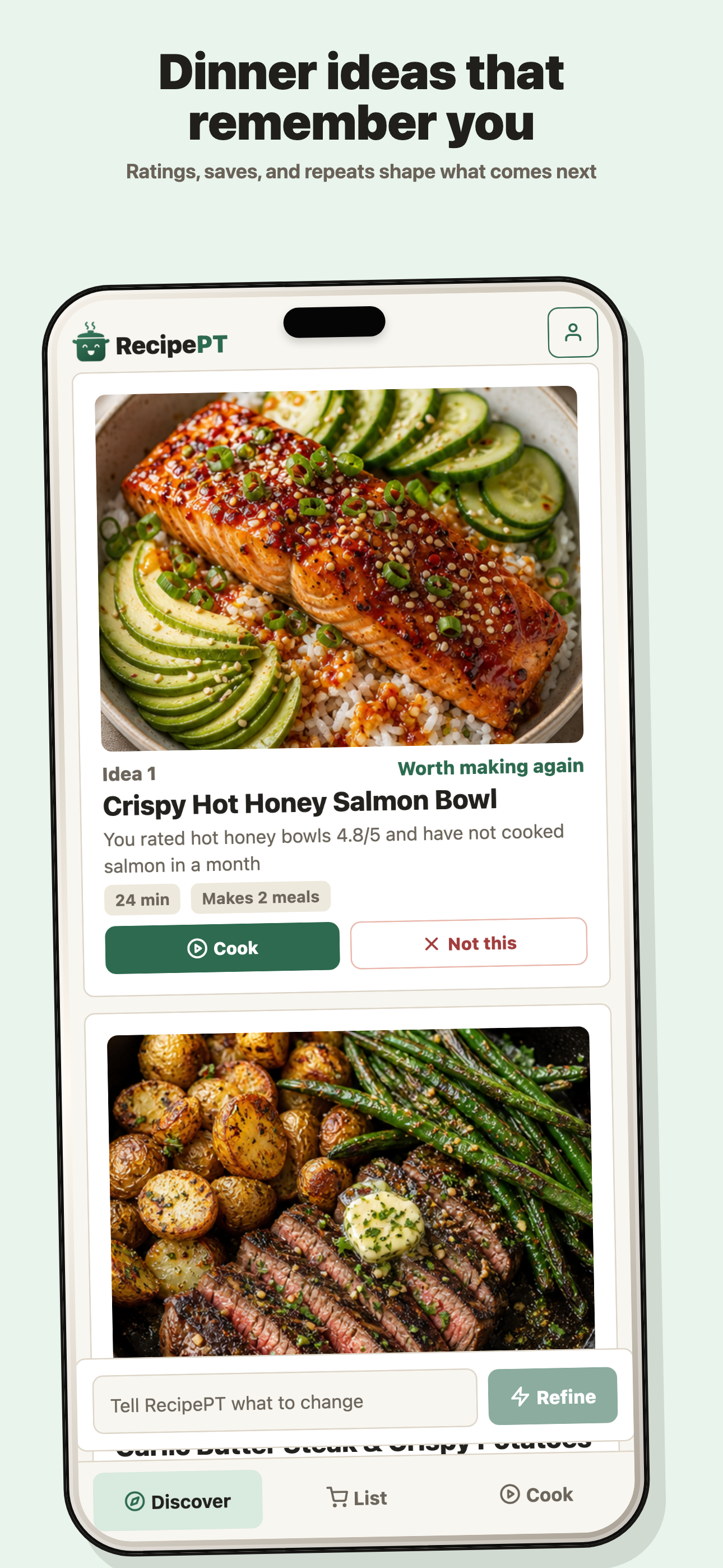
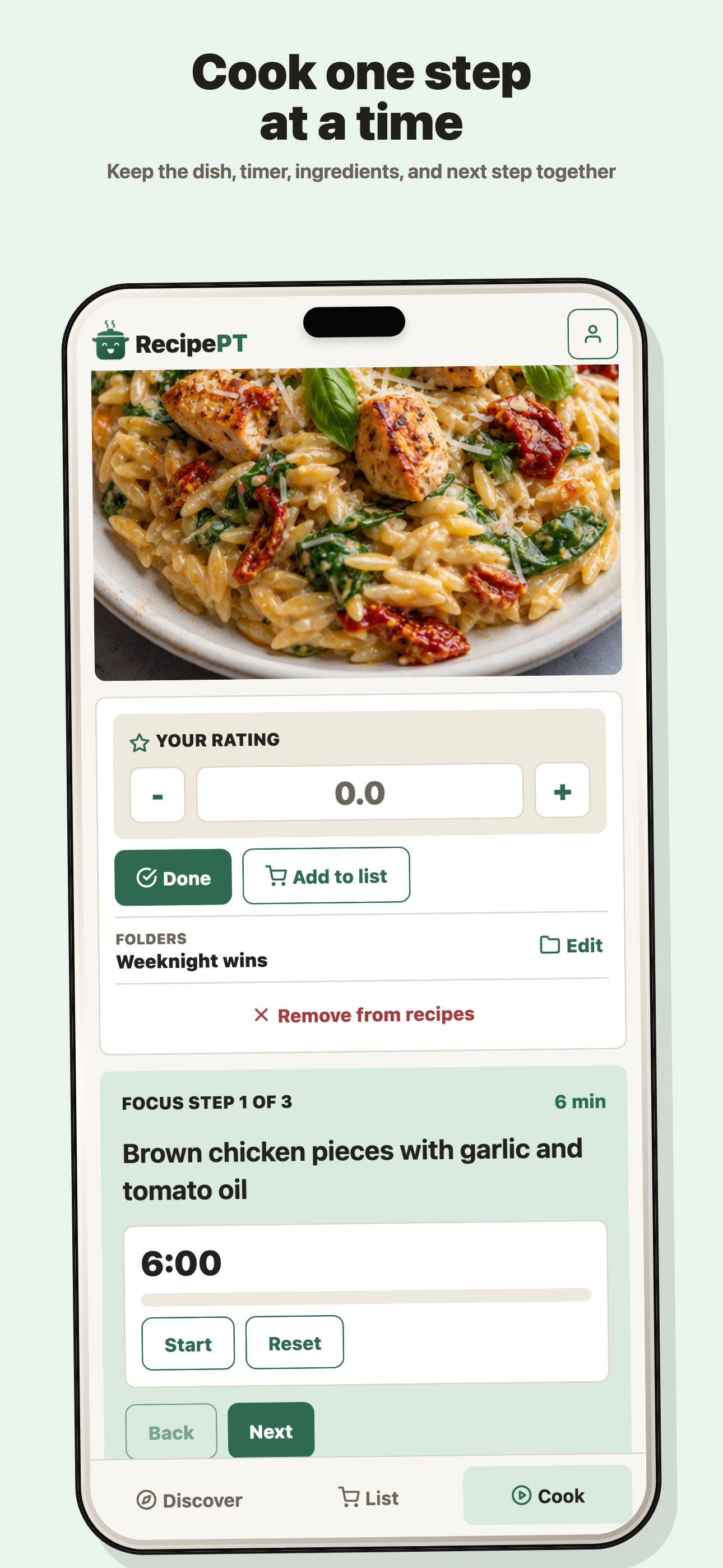
If none of the three fit your one non-negotiable, you do not start over. You steer in plain language: type "under 30 minutes", "no onions", or "lighter" and the set adjusts to your constraint. Then the part the method cannot do for you happens automatically: you pick one and it turns into a step-by-step cook mode, so the decision flows straight into cooking instead of straight back into second-guessing.
Let RecipePT decide tonight
Dinner ideas made for your taste, refined by typing what you want, so the deciding is done in seconds.
Get RecipePT on iPhoneCommon questions
How do I decide what to make for dinner quickly?
Name the one thing tonight's dinner has to be, take the first option that clears it, and lock the choice so you stop reconsidering. Deciding stalls when you hunt for the best possible meal. Pick the first good-enough one that fits your single non-negotiable and you are done in under two minutes.
Why is it so hard to decide what to eat every night?
Because you are trying to optimize a low-stakes choice at the end of a long day, when your capacity to decide is already spent. Deciding what to eat is not hard because you lack options. It is hard because you keep reopening a decision instead of committing to a good-enough one.
What should I do when nothing sounds good for dinner?
Stop looking for something that excites you and pick something that is fine. When nothing sounds good, that is usually decision fatigue, not an empty kitchen. Fall back to your default dinner, the one meal you can make without thinking, and just make it rather than waiting for a craving that is not coming.