AI dinner apps
Which Recipe Apps Actually Learn Your Taste? FoodiePrep, Crumb, Yummly, and RecipePT Compared

Quick answer: Three of the four are live, and they remember different things. FoodiePrep holds your diet, goals, and saved cookbooks. Crumb tracks your kitchen and what's expiring. RecipePT builds a taste profile from what you rate, cook, and refine, so tonight's picks shift as your household does. Yummly shut down on December 20, 2024.
Nearly every recipe app now claims to be personalized. In practice most of them mean one thing: you answered a diet question during setup and they filtered a database with it. That is a preference setting, not learning. This is an honest look at what four commonly recommended apps actually retain about you, including one that a lot of "best of" lists still recommend even though it no longer exists.
Which recipe app actually learns what you like?
Three of the four are live. FoodiePrep and Crumb personalize mostly from setup answers and your pantry contents. RecipePT is built around ongoing memory, shaping each night's three picks from what you rate, cook, and refine. Yummly, still named on many lists, shut down on December 20, 2024.
The reason the category is confusing is that "personalized" covers two very different things. One is a filter: you told the app you are vegetarian, so it stopped showing you pork. That is useful and it is also static, because you configured it once and it never changes on its own. The other is memory: the app watches which dinners you actually cook and which you skip, and next week's suggestions are different because of it. Reading the App Store listings for the apps below, the first kind is what most of them describe: a setup questionnaire, a diet setting, a pantry you maintain. Ongoing memory is harder to put on a feature list than a recipe count, so it tends to go unmentioned even where it exists. Which means the listing will not answer this for you. You have to test it. The reason so few apps do the second kind is architectural rather than lazy, which our founder wrote about in Every Recipe App Is Still Just a Filter: in a tag-and-filter database there is nowhere to put your taste.
Why does Yummly keep getting recommended if it shut down?
Because search results and AI answers lag reality. Whirlpool laid off the entire Yummly team in April 2024 and the app and site closed on December 20, 2024. Checked in July 2026, yummly.com now redirects to KitchenAid's recipe pages and the iOS App Store listing returns a 404.
This matters beyond trivia, because Yummly was the app most often held up as the one that learned your taste. It asked about diets, allergies, and disliked ingredients, then tuned its recommendations over time. Whirlpool acquired it in 2017, cut the team in April 2024, and shut the product down that December, telling users it was adjusting its operating model. If you follow a 2026 listicle to Yummly, you will land on a KitchenAid recipe index instead.
Worth taking from it: Yummly's shutdown is the clearest argument for checking whether an app is still maintained before you invest years of saved recipes in it. Users had no bulk export, so saved collections had to be pulled one at a time before the lights went out. Whatever you pick, favor something you can get your recipes out of.
FoodiePrep vs Crumb vs RecipePT: what does each one actually remember?
FoodiePrep remembers your diet, goals, and saved cookbooks, and plans weeks around them. Crumb remembers your kitchen, tracking what you own and when it expires. RecipePT remembers your taste, building a profile from the dinners you rate and cook. Different memories, aimed at different problems.
| FoodiePrep | Crumb | RecipePT | |
|---|---|---|---|
| Core job | AI meal planning for the week | Pantry tracking that turns into meals | Deciding tonight's dinner |
| What it mainly remembers | Diet, nutrition goals, saved cookbooks | What is in your kitchen and when it expires | What you rate, cook, and ask for |
| Standout feature | Weekly plans plus nutrition tracking | Receipt and photo scanning, voice ingredient entry | Three picks you refine by typing |
| Platforms | iPhone, iPad, Mac, Vision | iPhone, iPad, Mac, Vision, Android | iPhone |
| Price | Free to download, in-app tiers listed at $4.99 and $8.99, plus $59.99 annual | Free to download, Crumb AI listed at $3.99 monthly or $29.99 yearly | Subscription, one-week trial |
Pricing and platform details above are taken from each app's linked App Store listing as of July 20, 2026. The Crumb here is Crumb: Kitchen Recipes & Meals, since more than one app ships under that name. Listings change, so check the current page before you buy. The honest read on the table: none of these three is strictly better than the others, because they solve different shortages. If your problem is that the week is chaotic and you want plans plus macros, FoodiePrep is aimed squarely at that. If your problem is that food rots in the back of the fridge, Crumb's scanning and expiry reminders address a real cost nothing else on this list touches. If your problem is the 6pm stall, where you have plenty of options and still cannot pick, that is a decision problem, not a planning or inventory problem.
What should "learns your taste" actually mean?
Three tests. Does it change without you configuring it, updating from what you cook rather than what you declared? Does it persist, so you never re-explain no mushrooms? And does it act on negatives, the specific dislikes that rule out an otherwise fine dinner? Fail any one and it is a filter wearing a nicer name.
Use those three as your buying test, in any app, including ours. Taken one at a time:
- It updates from behavior, not just declarations. Setup answers capture who you thought you were in that moment. What you actually cook on a Tuesday is better evidence. If nothing shifts after twenty dinners, nothing is learning.
- It persists across sessions. This is exactly where general chat assistants fall down: every new conversation is a blank slate, so you re-type the household rules nightly. We wrote about that pattern in why ChatGPT keeps forgetting what you like.
- It handles negatives. Real households are defined by their exclusions: no onions, one kid who will not eat anything green, nobody wants soup in July. Positive preferences are easy. Reliably never suggesting the thing again is the hard part, and it is what makes suggestions feel personal.
How does RecipePT learn your taste, specifically?
It builds a taste profile from what you rate and cook, then filters every set of three ideas through it. You steer with plain language rather than settings: type "no mushrooms" or "lighter" and the ideas re-form. Allergies are a separate hard filter, not a preference the AI weighs.
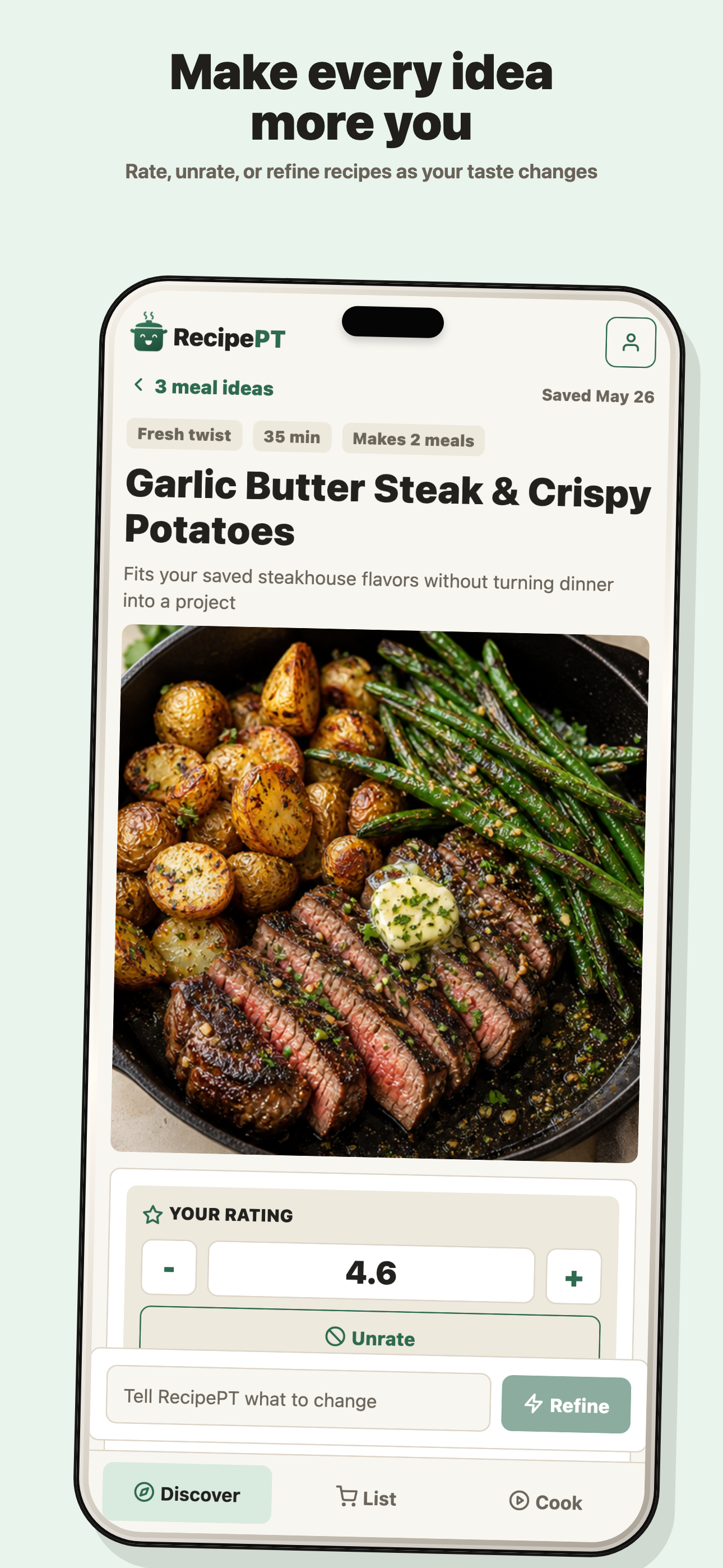
Here is the loop as it actually runs. You open the app and get three dinner ideas, not a grid. Anything that is wrong you say out loud in the box: "we had pasta twice this week", "something the kids will eat", "make it a sheet pan". Those refinements are the training signal, along with the star rating you give a dish afterward and what you actually cook. Over a couple of weeks the Taste Profile fills in with the flavors, cuisines, and proteins your household leans on, and it will tell you that you cooked something twelve days ago, which is usually the fact that settles the argument about whether to repeat it.
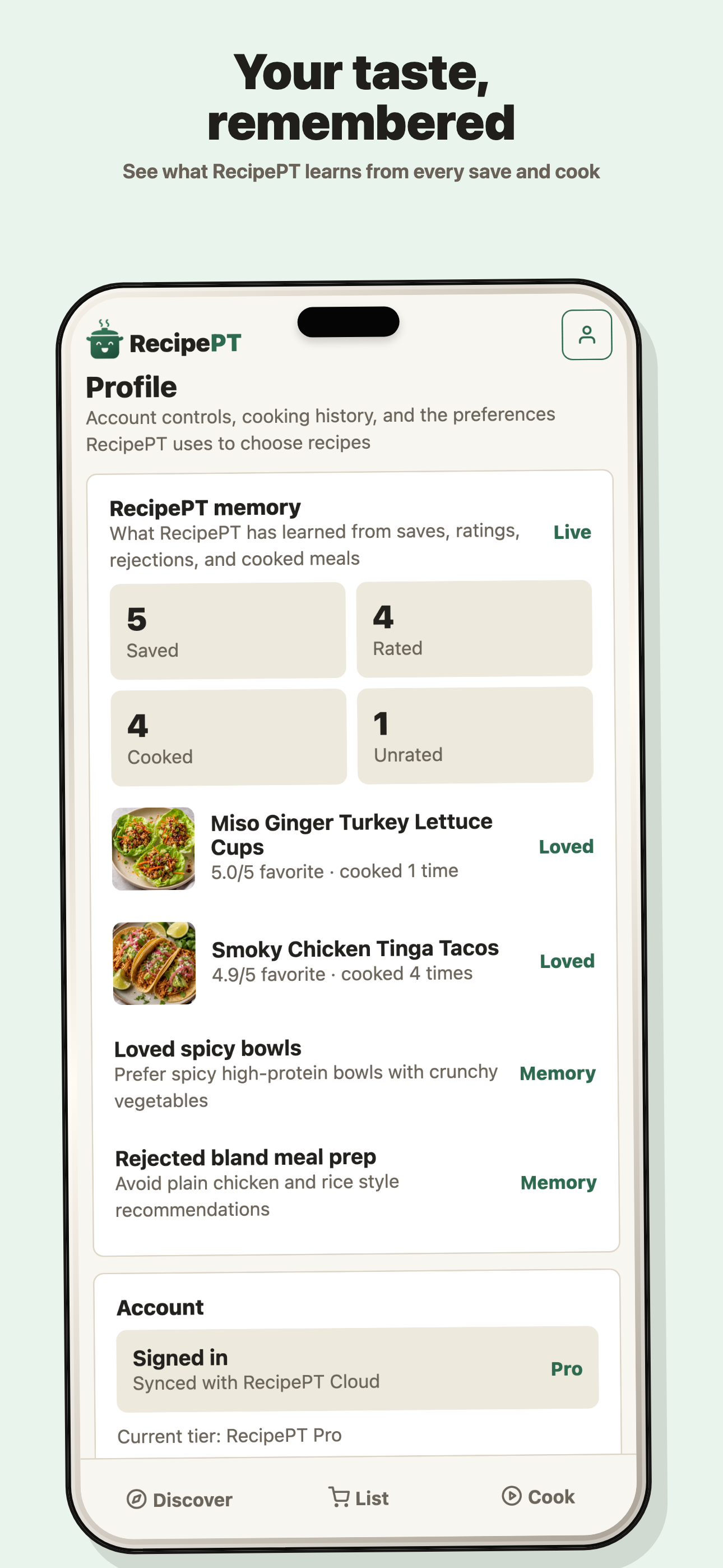
The part that separates this from a filter is the refine step, because it works on one idea at a time as well as all three. If two of tonight's picks are right and the third is wrong, you do not start over. You push on the one you like: make it lighter, swap the starch, feed four instead of two. That is the same mechanic as the list-versus-decision gap we wrote about with ingredient search, applied to taste instead of inventory.
Two honest limits. RecipePT is iPhone only right now, so if you are on Android, Crumb is the one of these three you can actually install. And it is a paid subscription with a one-week trial, not a free app, so if free is the requirement, it is not the pick. Where it earns its place is the specific night you have food in the house, no dietary crisis, and simply cannot decide.
Let it learn what you actually eat
Dinner ideas shaped by what you have rated and cooked, refined by typing what you want instead of tapping filters. On iPhone, with a one-week trial.
Get RecipePT on iPhoneCommon questions
Which recipe app actually learns your taste?
Of the apps people ask about, three are live: FoodiePrep, Crumb, and RecipePT. FoodiePrep and Crumb personalize mainly from what you tell them at setup plus what is in your pantry. RecipePT is built around ongoing memory: it shapes each night's three picks from what you rate, cook, and refine, so the profile changes as your household does. Yummly, still widely recommended, shut down on December 20, 2024.
Is Yummly still available?
No. Whirlpool laid off the entire Yummly team in April 2024 and the app and website shut down on December 20, 2024. As of July 2026, yummly.com redirects to KitchenAid's recipe pages and the iOS App Store listing returns a 404. Any list still naming Yummly as a recipe app that learns your taste is out of date.
What is the difference between a diet setting and an app that learns your taste?
A diet setting is a filter you write once: vegetarian, keto, no shellfish. It removes food but never learns preference. Real taste learning updates from behavior, which dishes you rate well, which you cook twice, which you scroll past, and it survives across sessions without you re-explaining anything.