
Dinner decision fatigue
How Couples Can End the “I Don’t Know, What Do You Want for Dinner?” Loop in 60 Seconds

Quick answer: Stop asking both people to invent dinner at once. Assign two roles: one partner is the Starter and names one workable dinner; the other is the Closer and either accepts it or changes one constraint. After one repair, decide or use your fallback. Swap roles next time so the mental load does not settle permanently on one person.
“What do you want for dinner?” sounds considerate, but it hands a blank page to someone who may be just as tired as you are. “Anything is fine” hands the page back. The loop continues because both people are doing the same vague job and neither has the authority to finish it.
Current search results mostly offer elimination rules, restaurant wheels, or mutual swiping. The Scullery method narrows the question before choosing, while Hangrily looks for restaurant matches through independent swipes. This guide solves a different problem: how two people can divide the labor of one home-dinner decision without turning dinner into a vote.
Why do couples get stuck in the same dinner loop?
The question gives both people the same job: generate a perfect answer while protecting the other person from disappointment. One defers, the other proposes cautiously, and every weak rejection reopens the whole search. The loop ends when generation and approval become separate jobs with a clear stopping rule.
This is not a diagnosis of the relationship. Sometimes both people truly have no preference. Sometimes one person knows exactly what they do not want but cannot name what they do want. Sometimes the hidden argument is about who cooks, who shops, or who is expected to remember every household limit. A dinner rule should expose that difference rather than bury it under more suggestions.
The individual version of this problem is a blank-page failure. Our candidate-first rule fixes that by reacting to one dinner instead of recalling every dinner you know. The couples version adds a second problem: deciding who supplies the candidate and who gets to close it.
What is the 60-second Starter and Closer handoff?
The Starter produces one dinner that fits the limits on the table. The Closer says yes or repairs one dimension without sending the decision back to zero. A repair could change the base, effort, cuisine, or cooking method. After that revised candidate, the Closer commits or triggers the agreed fallback.
- 0 to 10 seconds: each person states one hard limit for tonight.
- 10 to 25 seconds: the Starter names one concrete dinner, not a cuisine category.
- 25 to 40 seconds: the Closer accepts it or makes one specific repair.
- 40 to 55 seconds: the Starter returns the repaired candidate.
- 55 to 60 seconds: the Closer commits, or the fallback wins.
The clock is a boundary, not a performance test. If the conversation takes seventy seconds, nothing has failed. The useful constraint is that one rejected idea cannot reopen every restaurant, recipe, and grocery in reach. The repaired candidate gets a decision, not another brainstorming round.
What should each person say before the Starter names dinner?
State one hard limit each, not a wish list. Useful limits change the decision: no shopping, twenty minutes, no pasta tonight, use the chicken, or order instead of cook. “Something good” and “nothing too heavy” still require interpretation. Two concrete boundaries are enough to make the Starter’s job smaller.
A limit should describe tonight, unless it is a permanent food rule. “No pasta tonight” is a current preference. An allergy, religious rule, or ingredient somebody cannot eat is never a bargaining chip and should already sit outside the one-limit budget. Safety and durable household rules apply before this conversation starts.
If the real issue is labor, say that directly. “I can choose, but I cannot cook” is more useful than “I do not care.” “I can cook for twenty minutes if you clean” is a workable boundary. The method only chooses food well when the effort agreement is visible too.
Why must a rejection include one repair?
A bare “no” destroys the only concrete progress and returns all the work to the Starter. A repair keeps what already fits and changes the reason it failed: “not pasta, same effort,” “warm instead of cold,” or “vegetarian, but keep the tacos.” The Closer contributes information without having to invent dinner from scratch.
The repair must be usable. “Not that mood” may be emotionally accurate, but it does not tell the Starter what can survive. Name the dimension that broke: ingredient, format, temperature, effort, cost, or whether you are cooking at all. A repair is not a counterargument. It is one edit to the current candidate.
If the Closer already has a specific replacement, say it. The rule is not meant to suppress a real preference. “Actually, I want breakfast sandwiches” closes the decision faster than carefully editing chicken bowls. The method exists to move information forward, not to make the conversation ceremonial.
How do you keep one partner from becoming the permanent dinner manager?
Swap roles by a rule you can see. The person who closes tonight starts next time, or alternate Starter days on a shared calendar. Do not rely on remembering who chose last. Role rotation distributes both invention and responsibility, while still letting the person with a hard schedule or cooking task speak first.
Equal turns are not the same as equal workload. If one person shops, cooks, tracks allergies, and notices what will spoil, asking the other person to name dinner once does not balance the system. The handoff is a tiny operating rule, not a cure for an unequal household. Use it to make the deciding visible, then decide separately how the wider work should be shared.
If the nightly conversation keeps failing in the same place, move up a level. A named fallback, a short rotation, or flexible weekly plan may remove the recurring decision entirely. The guide to five dinner systems ranked by total mental cost helps match the system to the actual failure point.
What if your two hard limits genuinely conflict?
Name the conflict instead of negotiating around it. If one person needs a quiet no-cook night and the other wants a full cooking project, one shared dinner may be the wrong requirement. Choose compatible components, make separate simple meals, or use the fallback. Agreement about dinner does not always require identical plates.
The same applies when dietary needs leave no safe shared option. Do not use the one-repair rule to bargain somebody out of a medical, ethical, or religious boundary. Separate meals can be the lower-friction answer. The useful shared decision may be who handles which food and when the kitchen is free.
A method that only works when both people secretly want the same thing is not much of a method. The stop rule protects the evening when the constraints do not overlap. It is better to identify that in one minute than to discover it after twenty minutes of increasingly resentful suggestions.
How can RecipePT take the Starter role without pretending to decide for both people?
RecipePT can supply a small candidate set from the signed-in account’s household settings, taste history, and food rules. It does not merge two profiles or run a couple’s vote. One partner can nominate an idea, the other can accept or state one repair, and that repair can be typed into the refinement field.
The current result screen shows this division clearly. The named Crispy Hot Honey Salmon Bowl carries a 24-minute estimate and a reason based on a past rating and time since salmon was cooked. “Not this” remains visible, as does the field labeled “Tell RecipePT what to change.” Those controls were checked in the current app strings and customization rules on October 14, 2026.
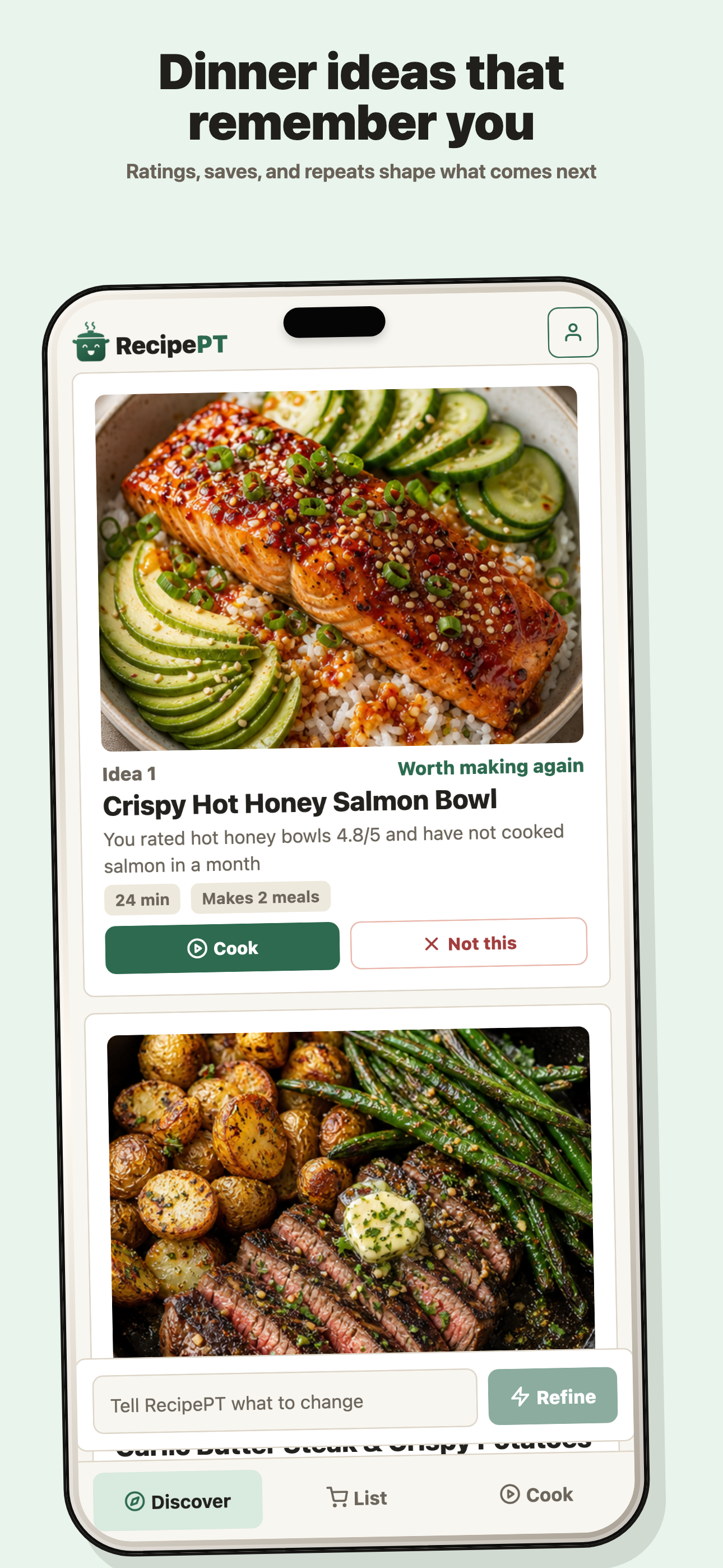
Use the product honestly. The account holder should name the other person’s permanent restrictions in the household rules, then add tonight’s limits to the current request. If the partner says “same effort, no rice tonight,” type that repair. A plain “Not this” requests a genuinely different dish, while a specific tweak preserves what still works.
When should the fallback end the conversation?
Use the fallback after the original candidate and one repaired candidate both fail, or whenever the effort limits never overlap. Pick the fallback while calm: a freezer meal, eggs and toast, separate sandwiches, or a reliable order. Its job is not to delight both people. Its job is to end the loop kindly.
A fallback must be specific enough to execute. “We will figure something out” is not one. Neither is reopening a delivery app with eighty restaurants. Name the meal or the order. Keep the ingredients if it is a home option. Decide who initiates it. The fallback only absorbs mental load when no fresh decision is hiding inside it.
If fallback nights become most nights, the problem may not be dinner indecision. The schedule may be too tight, the pantry may not support the week, or cooking labor may be assigned badly. Keep the one-minute rule, but fix that larger constraint away from the hungry part of the day.
How is this different from the usual “just offer three choices” advice?
Three choices still leave both people evaluating, vetoing, and wondering whether a better option was omitted. The handoff assigns ownership: one person starts with one answer, the other finishes it or makes one repair. The value is not a magic number of options. It is a path from blank question to named decision.
Choice lists can still help the Starter generate a candidate. They just should not become the couple’s next shared task. If an app shows three ideas, the Starter silently chooses the one they can support and names it. The Closer reacts to dinner, not to a miniature search-results page.
That separation is the post’s point of view. The problem is not that couples lack dinner ideas. It is that an open question makes two people perform invention, diplomacy, and approval at the same time. Split those jobs, allow one repair, and make stopping part of the method.
Want RecipePT to supply tonight’s first candidate?
Let one person start from dinner ideas shaped by the household’s saved rules and cooking history. Name one candidate, take one repair from your partner, and refine it in plain language. Available on iPhone.
Get RecipePT on iPhoneWhat else do couples ask about deciding dinner?
How do couples decide what to eat without going back and forth?
Give each partner a different temporary job. The Starter names one concrete dinner that fits tonight. The Closer either accepts it or changes one constraint, such as the base, effort, or cuisine. After one repaired candidate, commit or use the fallback. Swap roles next time so one person does not become the permanent dinner manager.
What should I say instead of “I don’t know, what do you want?”
If you are starting, say one real candidate: “Chicken bowls?” If you are closing, answer “yes” or make one usable repair: “Same effort, but no rice tonight.” Avoid “anything,” “whatever,” and an unsupported veto. The point is not perfect communication. It is giving the next person something specific enough to finish.
What if neither partner likes the repaired dinner idea?
Use the fallback you agreed on before the conversation, or make separate simple meals if your needs genuinely conflict. Do not restart the entire search after two workable candidates fail. A fallback is not a punishment or a relationship loss. It is the boundary that prevents a small dinner choice from consuming the rest of the evening.
Can RecipePT combine two partners’ taste profiles?
No. RecipePT uses the signed-in account’s household settings, saved food rules, and taste history. It does not merge two accounts or run a shared vote. A couple can still use it as the Starter: one person nominates an idea, the other accepts or states one repair, and that change can be typed into the refinement field.