Deciding tonight
Why You Can't Decide What to Eat for Dinner (and the One Rule That Ends the Nightly Stall)
Ask yourself what you want for dinner and you get nothing back. Have someone suggest tacos and you know within half a second whether that is right. Same brain, same kitchen, same evening. The difference is which direction the question runs, and it is the most useful thing to understand about the nightly stall.
Why can't I decide what to eat for dinner?
Because the question asks you to produce a dinner out of nothing, and naming something from memory is much harder than recognizing it. You are not short of options or willpower. You are being handed a blank page at the hour you have the least left to fill one with.
Your memory is far better at confirming than at retrieving. Recognizing an answer that is put in front of you is close to instant, while pulling one out of an unprompted mind is slow and unreliable, which is why a name you cannot summon at all arrives the moment somebody says it. Dinner is the same trick played on you every evening. "What do you want to eat" is a retrieval question with no cue attached and no bounds around the answer, and it is being asked of you at 6pm.
This is also the mechanism behind the loop every household knows. You ask what they want, they say they do not mind, you say you do not mind either, and twenty minutes disappear. Nobody in that exchange is being difficult. Both people are being asked to generate, and both are stuck in the direction that stalls. Notice how fast it resolves the second one of you says something concrete, even something bad. "Pasta?" gets a real answer immediately, and the answer is often no, which still moves things forward.
It also explains the open fridge. Standing there is mildly useful, not because there is a plan on the shelves, but because half-used peppers and a block of feta are cues, and cues are what a stalled recall was missing. The trouble is that a fridge cues about eleven things and most of them are yogurt. The hour itself makes all of this heavier, which we went through in dinner decision fatigue. This piece is about the shape of the question rather than the state you are in when you meet it.
What is the one rule that ends the stall?
Stop trying to name a dinner and put one in front of yourself to react to, even a wrong one. "Not that, too heavy" is real information that you could not have generated from an empty page. Two rounds of reacting usually lands you on something you actually want to eat.
The rule is: never answer a blank page, always answer a candidate. It costs nothing to run without an app, and it is three steps.
- Name one dinner, any dinner. The first thing that surfaces, however unappealing. It is not a proposal, it is a probe, so a bad one works as well as a good one.
- Say what is wrong with it, out loud. Fried rice, and immediately: too much chopping. So tonight is a low-effort night, which you did not know ten seconds ago and could not have retrieved by asking yourself how much effort you were up for.
- Probe again with what you just learned, and stop at three. Low effort, so: quesadillas? Now you are choosing rather than generating, which is the direction that works.
What makes this work is that a rejection carries more usable detail than a request does. "I want something good" narrows nothing. "Not soup, I want to chew something" rules out a third of the possible evening and points at the rest. Preferences are much easier to find by bumping into their edges than by introspecting, and a wrong suggestion is the cheapest possible edge to bump into.
Saying it out loud or typing it matters more than it sounds like, because the version that stays in your head stays vague. The cap matters too: the point is to arrive somewhere, not to audition dinners. Still circling after three rounds, and you are in the commitment problem instead, which has its own fix in how to decide in under 2 minutes.
Why does scrolling a recipe feed make this worse?
Because scrolling past a card is not the same move as rejecting it. A rejection only helps when something receives it and the next candidate changes in response. Swiping past two hundred dinners produces no information and leaves the two hundred and first exactly as unrelated to you as the first.
This surprises people, because a feed looks like exactly the fix described above. It is showing you candidates, so why does it not work? Two reasons, and they are both about what your no does.
The first is that a scroll throws the no away. In the rule above, the useful part was not seeing fried rice, it was saying too much chopping and having the next thought narrow because of it. A feed never receives that sentence, so you keep recognizing and never accumulate anything. Scrolling feels like progress and functions like shuffling a deck.
The second is that an endless list quietly changes the question you are answering. Recognition is fast at "would I happily eat that," and slow to the point of useless at "is that better than the hundred and ninety I have not seen yet." An open-ended feed keeps asking the second one, which is why you finish it hungrier and no nearer to dinner. If you would rather not have this argument at 6pm at all, most of it can be settled on a calm Saturday instead, which we went through in deciding once instead of nightly.
What if nothing sounds good at all?
That is a different stall, and narrowing will not fix it. When nothing appeals, your appetite is missing rather than your options. Decide on texture, temperature and effort instead of on a dish: something warm, soft, under twenty minutes. If it still will not resolve, fall back to the dinner you settled on months ago.
Tell the two apart before you spend any more of the evening. If a suggestion makes you react, even negatively, you are in the recall stall and the rule above will land it. If every suggestion lands the same flat nowhere, you are either not hungry yet or tired enough that food has stopped registering, and no amount of better options will produce an appetite.
For that case, drop the dish level entirely and choose on properties: hot or cold, soft or crunchy, under twenty minutes or worth an hour. Those questions have answers when "what do you want" does not, and they describe a dinner well enough to start cooking one. If even that stalls, fall back to the dinner you already decided on months ago. A named fallback earns its place here precisely because it asks nothing of your memory: boxed mac and cheese with frozen peas stirred through it is on the shelf and settled. Reaching for it is not abandoning the decision, it is spending one you made in advance.
How does RecipePT turn the question into something you can react to?
It opens with ideas rather than a search box, so your first move is reacting instead of recalling. Saying no is a supported input: "not this" returns a genuinely different dish, and "more like the last one" is read as a pull toward that dish rather than a complaint about it.
RecipePT is built around the direction of the question. You never have to type a dish, because typing a dish is the step you are stuck on. It opens with a small, closed set of ideas shaped by your allergies, your standing no's and the meals you have rated and cooked, and you react to those.
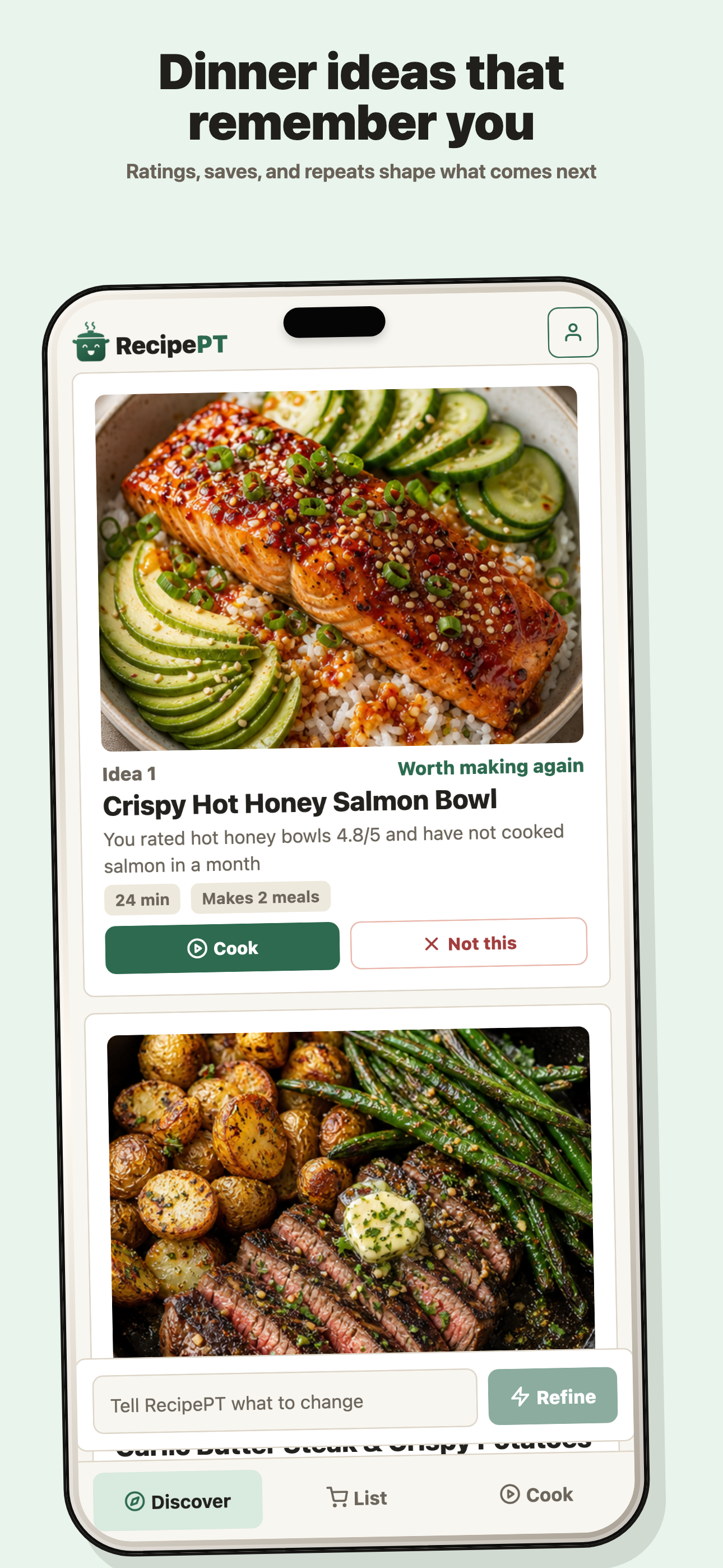
The rejections are the interesting part, because they are handled as first-class instructions rather than as a refresh button. Under the hood, "something else", "not this" and "another option" are routed as a replacement, which means a genuinely different dish in the same slot, with an explicit rule against handing back the same recipe with one ingredient word swapped. Meanwhile "lighter", "milder" or "make it quicker" are routed as a tweak, keeping the dish you are looking at and adjusting it. Those are two different things you might mean by no, and telling them apart is most of what makes reacting feel productive rather than like reloading.
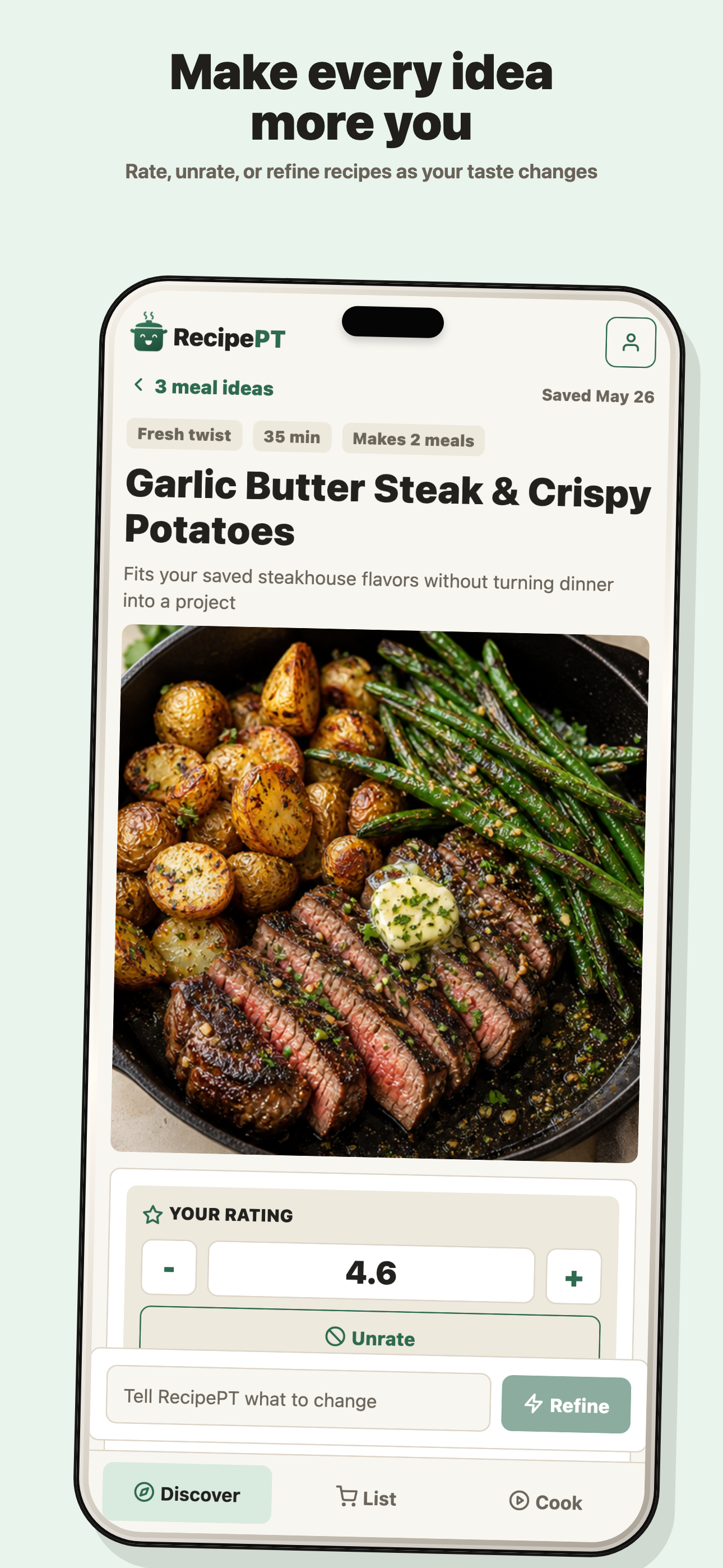
The reference case is handled too, and it is a fiddly one. "More like the beef skillet" contains the word beef next to a request to change something, and the naive reading is to treat beef as the thing you are objecting to. It is specifically read as a positive reference instead, so pointing at a dinner you liked pulls the next set toward it. Whether a no is durable also gets decided: "no pasta tonight" applies to tonight only, while "I can't eat pasta" becomes a standing constraint, a distinction we go into in "no mushrooms" and "I can't eat mushrooms".
The honest limit is that it cannot see your fridge, so the half-used peppers only count if you mention them. And it will not manufacture an appetite on a night when you have none. What it removes is the blank page, which is the part of dinner you were actually stuck on. Once you pick one, it becomes a grocery list or a step-by-step cook, so the decision runs straight into the cooking instead of back into second-guessing.
Answer a candidate, not a blank page
RecipePT opens with dinner ideas shaped by what you can't eat and what you've liked before, so you start by reacting. Say what's wrong in plain language and the next set moves toward you. On iPhone.
Get RecipePT on iPhoneCommon questions
Why can't I decide what to eat for dinner?
Because the question asks you to produce a dinner out of nothing, and naming something from memory is much harder than recognizing it. You are not short of options or willpower. You are being handed a blank page at the hour you have the least left to fill one with.
Why do I say "I don't know" when someone asks what I want to eat?
Because you have been asked to generate, and generating is the direction that stalls. The same person naming two candidates gets an answer from you in seconds, which is why the loop breaks the moment somebody suggests something specific rather than asking again.
What should I do when nothing sounds good for dinner?
Treat it as an appetite problem rather than an options problem, because narrowing will not help. Choose on texture, temperature and effort instead of on a dish: something warm, soft and under twenty minutes. If that still stalls, fall back to the dinner you settled on months ago.
Does scrolling recipes help me decide faster?
Usually not, because scrolling past a card is not the same move as rejecting it. A rejection only helps when something receives it and the next candidate changes in response. Swiping past two hundred dinners produces no information, so the two hundred and first is as unrelated to you as the first.