
Deciding tonight
Tired of Deciding What to Eat Every Night? Decide Once Instead of Nightly
Quick answer: Most of what you sort out at 6pm hasn't changed in months, so stop re-deciding it. Settle three things once: ten dinners your household reliably eats, one fallback you can cook half asleep, and the constraints that never move. Tonight's question shrinks to your appetite and what's about to go bad.
There's a specific kind of tired that has nothing to do with cooking. You answered this question yesterday. You answered it the day before. Tomorrow at about the same time it'll be back, and none of yesterday's thinking will be there waiting for you. That's the part worth fixing, and it's fixable without meal-prepping your Sunday away.
Why am I so tired of deciding what to eat every night?
Because it's the same decision a few hundred times a year and none of the work carries over. You solve it on Tuesday, and Wednesday hands you a blank page again. That's a different problem from one hard choice, which is why more recipes, more willpower, and a better search box never seem to touch it.
Why the exhaustion lands so hard at that hour, the end-of-day depletion and the anxiety that comes with unlimited options, we went through in dinner decision fatigue. This piece is about the repeat: the fact that solving dinner once buys you exactly one evening.
The reason nothing carries over is that you keep the answer in the worst possible place. Every night you re-run the same filter in your head. Who's home, who won't touch peppers, how long until someone melts down, what's in the fridge that'll be sad by Friday. Your head clears all of that by morning, so tomorrow you run it again from nothing. Written down, most of it would still be true in March.
What part of dinner actually has to be decided tonight?
Less than you'd think. Who's eating, what they can't eat, how much time a weeknight really gives you, and which dinners your household happily repeats are all stable for months. The parts that genuinely change by 6pm are your appetite and what's about to spoil. Everything else can be settled in advance.
Split the nightly question into two piles and the size of the problem changes:
- Stable for months. The standing no's, allergies and the dislikes nobody is negotiating. The realistic time ceiling on a school night. The dinners that have already worked more than once. The four or five things you always have in the house. Your fallback.
- Genuinely tonight. What sounds good. What's about to turn. How much energy you have left, which is usually less than the morning version of you assumed.
Almost everyone treats both piles as new information at 6pm. The first pile is where the tiredness comes from, and it's the pile you can answer on a calm Saturday and reuse until something in your life actually changes.
How do you decide once and actually reuse it?
Write down ten dinners you've cooked more than twice with no complaints. Name one fallback you can make half asleep. Write the two or three rules that never change, like no onions or nothing over 40 minutes on a school night. Keep all of it somewhere you'll see at 6pm rather than in your head.
Three pieces, and the constraints on each matter more than the contents.
The standing ten. Not recipes you'd like to try. Dinners with a track record. The qualifying rule is that a meal joins the list the second time you cook it, not the first, because the second time is when you find out whether you'd do it again on a Tuesday. Ten is enough to get through a week without eating the same thing twice, and short enough that reading it doesn't become its own chore. Swap one or two a month and it never goes stale.
One named fallback. Pick it while you're calm and well fed, because that's the opposite of when you'll need it. It should need no shopping and no thought: eggs and toast, pasta with garlic and oil, beans and rice. The value isn't the meal, it's that "I can't decide" already has an answer that isn't a delivery order.
The rules that never move. Two or three sentences, phrased as facts rather than moods. There's a real difference between the sentence that should last forever and the one that should expire by morning, and it's usually one word wide. We wrote about where that line sits in "no mushrooms" and "I can't eat mushrooms".
Why do meal plans stop working by Wednesday?
A week of planned dinners is a set of promises made by a rested Sunday version of you, and it survives only if the week cooperates. One late meeting, one missing ingredient, one kid who has suddenly turned on rice, and the assignment breaks. A standing shortlist keeps working because it never told you which night.
That's the difference worth understanding before you try another system. A plan assigns dinners to nights, which is brilliant for shopping and brittle for living. A shortlist is a set you pick from in any order, so a disrupted Wednesday costs you nothing. Theme nights sit in between: they remove the category decision and leave the details, and they hold up better than a full plan for exactly that reason.
Saved recipes are worth a mention, because most people's first attempt at this is a folder of them. A save is a decision you postponed. Four hundred saves are four hundred postponed decisions sitting in one place, and opening that folder at 6pm is the same problem again with worse lighting. A rotation list of ten works because it's short, tested, and closed.
The honest limit: none of this removes the nightly choice, it makes it small. You'll still pick between three or four things you'd be happy with. If you find yourself stalling even on a short list, the fix is a commitment rule rather than more options, and we laid one out in how to decide in under 2 minutes.
How does RecipePT hold the decide-once part for you?
It keeps the stable pile so you don't re-enter it. Your allergies and hard no's are treated as constraints it won't cross, your taste comes from what you rate and cook, and each evening it opens with a few ideas already shaped by both. What's left for you is the small part: what sounds good tonight.
The list-of-ten approach works on paper and still leaves you maintaining the list. RecipePT is the same idea with the upkeep taken off your hands. Instead of a feed to scroll, it gives you three ideas at a time, filtered by the things you told it once.
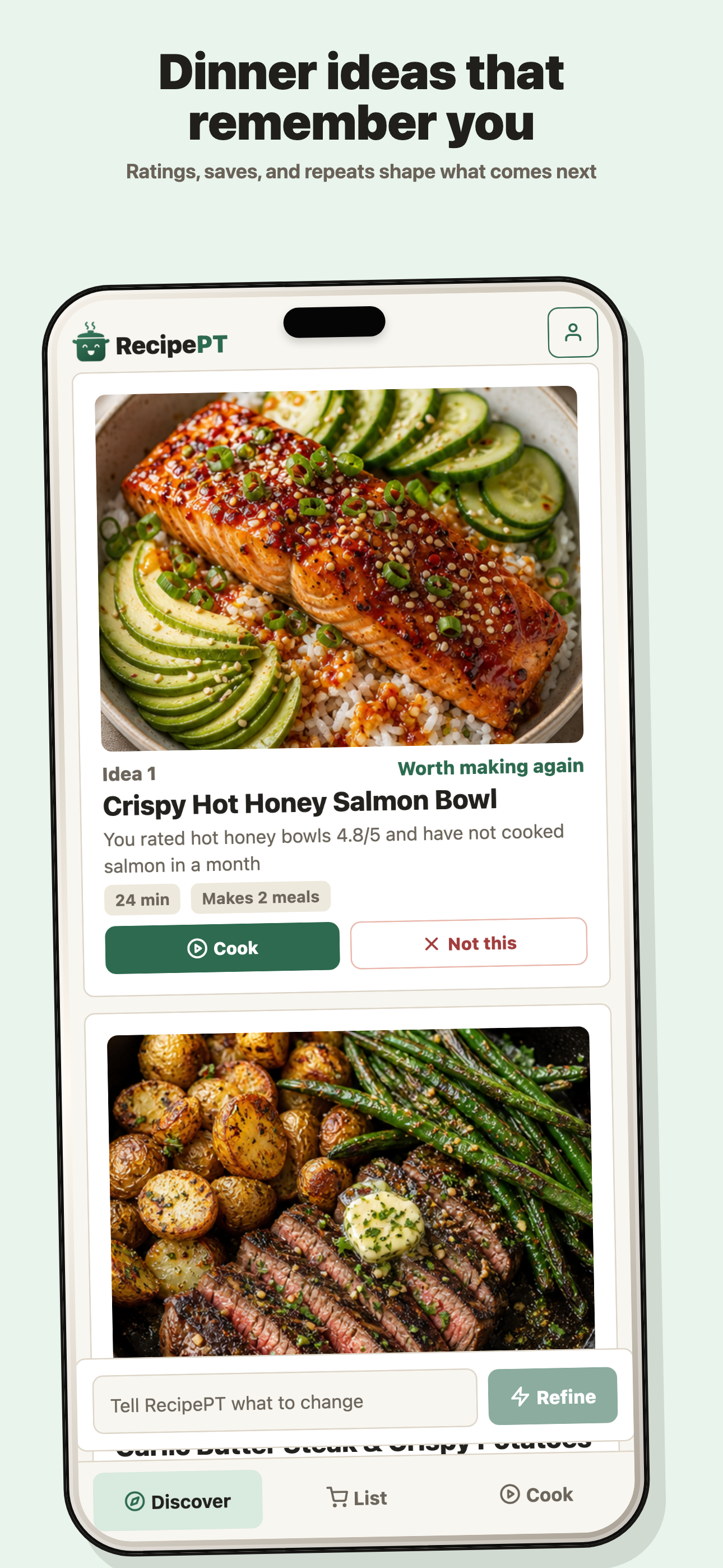
When tonight doesn't match the pattern, you say so in plain language. Type "lighter", "no chicken", or "use the spinach" and the set changes. What you type wins over what it has learned about you, deliberately, because a craving on a Thursday shouldn't have to argue with six months of history. Ask for something and you get it, even if it's out of character.
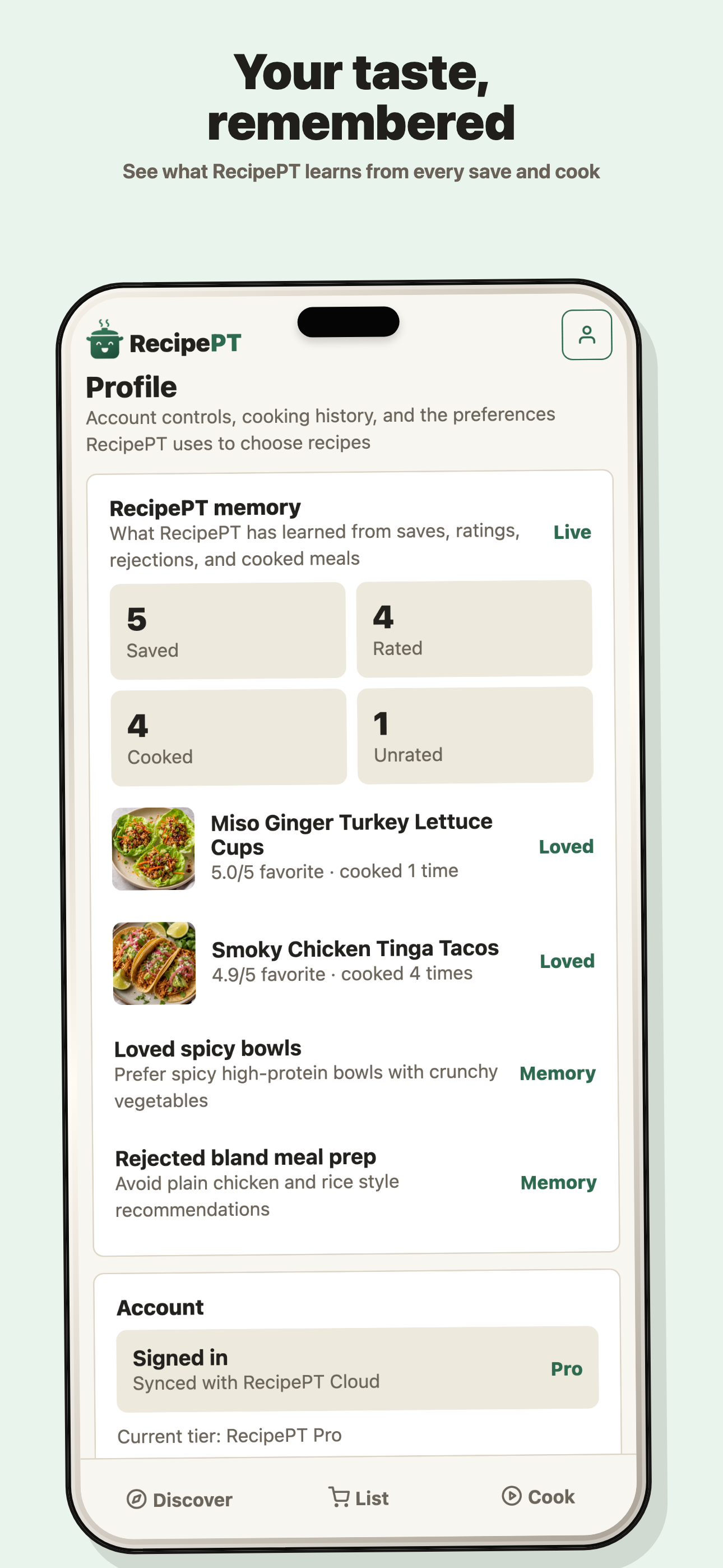
The ratings and the dinners you actually cook feed the next set, so the ideas keep getting closer to your household without you maintaining anything. The one thing it can't see is your fridge, so tell it what needs using and it'll build around that. Once you pick, it turns into a grocery list or a step by step cook mode, and the deciding runs straight into the cooking.
Let RecipePT hold the part that doesn't change
Say once what you can't eat and what you're into. It keeps that, learns from the dinners you rate and cook, and opens with ideas already shaped by it, so the nightly question stays small. On iPhone.
Get RecipePT on iPhoneCommon questions
How do I stop thinking about what to eat every night?
Move the stable parts of the question out of your head. Keep a written list of ten dinners your household reliably eats, name one fallback meal you can cook half asleep, and write down the two or three constraints that never change. At 6pm you're then choosing from a short list instead of starting over.
How many dinners should be in a rotation?
Ten to twelve is the practical range. Fewer than eight and you repeat inside the same week, which is where people get bored and abandon the list. More than fifteen and picking from it becomes its own decision, which defeats the point. Swap one or two out a month to keep it from going stale.
Is it bad to eat the same dinners every week?
Repetition isn't a problem by itself. Most households already cycle a small set without noticing. Aim for variety across a week rather than novelty every night, and treat boredom as the signal to rotate a couple of items rather than to scrap the list and go back to deciding from scratch.
Why does meal planning stop working after a few days?
Because a plan assigns specific dinners to specific nights, so it depends on the week going as expected. One late meeting or one missing ingredient breaks the assignment, and most people don't rebuild it mid-week. A standing shortlist survives disruption because it never told you which night anything had to happen.