
What should I cook tonight
Dinner for Picky Eaters Tonight: How to Decide With One Kid Who Won't Eat Anything
You already know fifteen things you could cook. What you need is the one that survives the person at the table who will not eat anything mixed, anything green, or anything that touched a sauce. That is a constraint problem, not a recipe problem, and it has a decision rule.
What should I make for dinner tonight if one kid won't eat anything?
Cook one dinner that comes apart. Pick a base everyone already accepts, cook the protein and the vegetable separately from it, and let people build their own plate. You are not making two dinners. You are making one dinner that can be served in pieces, which is the version that survives a table with a picky eater at it.
Almost every answer to this question is a list of recipes, and a list is the wrong shape for the problem. You do not lack ideas at 6pm. You lack one that will not end with a plate pushed away and cereal poured at 7. Stop choosing a recipe and decide how dinner gets assembled instead: if the components stay separate until they hit the plate, one dinner feeds the adult who wants the sauce and the seven year old who wants dry noodles and cheese. It is dinner decision fatigue with one more person voting.
Why does the same dinner get eaten one night and refused the next?
Because the refusal is usually about texture, mixing or unfamiliarity, not the ingredient itself. The same chicken is fine plain on Monday and rejected in sauce on Thursday. Work out which of those three is happening before you pick anything, and tonight's choice narrows from fifty options to about three.
Three axes cover most of it, and they call for completely different dinners.
- Mixing. Every food on the table is acceptable, but not touching, not coated, not stirred together. A casserole fails and the identical ingredients in three piles pass.
- Texture. Soft, slimy, stringy, or bits inside something otherwise smooth. It is why a kid eats raw carrot sticks and rejects cooked carrot, which reads as nonsense until you treat texture as the actual subject.
- Unfamiliarity. It looks or smells like nothing they have eaten before. Nothing you cook tonight fixes this one. Repeated low-pressure exposure does, over weeks, which is a different project than getting dinner eaten in the next hour.
It also helps to separate your job from theirs. The division of responsibility, the feeding framework from dietitian Ellyn Satter, puts the parent in charge of what is served and the child in charge of whether and how much they eat of it. As a decision rule that is freeing: stop hunting for the dish that guarantees a clean plate. It does not exist.
What are 3 dinners that survive a picky eater, and how do you choose one?
Match the dinner to the axis. Mixing problem: a build-your-own night. Texture problem: a sheet pan where nothing is sauced and one corner stays plain. Unfamiliarity problem: breakfast for dinner, where every item on the table is already known. Choose by recalling how the last bad night actually went wrong.
1. Build-your-own night, for the kid who will not eat mixed food
Tacos, rice bowls, or a baked potato bar. Brown a pound of ground beef, keep the seasoning mild, and put everything else out in separate bowls: cheese, lettuce, beans, salsa, sour cream, tortillas. Ground beef is done at 160°F internal, per the USDA safe minimum internal temperature chart. The adult plate gets six toppings. The kid plate is allowed to be a tortilla, cheese and three pieces of meat, and that still counts as eating the dinner you made. Nobody negotiates about the contents of a casserole when there is no casserole.
2. Sheet-pan chicken and potatoes, for the texture objector
Oven to 425°F. Halve baby potatoes, toss with oil and salt, and give them a head start of about 15 minutes. Add boneless skinless chicken thighs and roast until the chicken reaches 165°F internal, the USDA safe minimum for all poultry and the only number worth trusting over a clock. Broccoli florets go in for the last 15 to 18 minutes. Keep one corner of the pan plain: oil and salt, no herbs, no pepper, no glaze.
Roasting beats steaming for a specific reason: dry heat drives off water and browns the surface, so you get crisp edges instead of the soft wet texture most vegetable refusals are about. Sauce goes in a bowl on the side, always, for everyone.
3. Breakfast for dinner, for the night novelty will not survive
Scrambled eggs cooked until firm, toast, bacon or sausage, and fruit. Every component is separately recognizable and none of it is a surprise. Reach for this on the night there is no patience left in the house, yours included.
The 30 second rule for choosing: think about the last dinner that went badly and ask what the complaint was. "It was all mixed together" points to pick one. "It was slimy" or "there were bits in it" points to pick two. "I don't like it," said before tasting it, points to pick three. If you cannot remember, take the build-your-own night, because it fails safest.
How do you get the vegetable eaten without a fight?
Put it out first, plain and cold, while everyone is hungry and dinner is still five minutes away. Keep the pieces separate and undressed, offer one familiar dip beside it, and then say nothing at all about whether it gets eaten. The commentary is usually what turns a vegetable into a negotiation.
Serve it in the hungriest window, the ten minutes before dinner is ready, not the point in the meal when they are already full of pasta. Serve it in a form they have accepted before, even if that form is raw, because crunchy and cold clears the texture objection that cooked and soft creates.
Blending vegetables into a sauce is a legitimate parallel path. Just be clear it is a different goal: hidden vegetables feed the kid tonight, visible ones build acceptance over months.
How does RecipePT help decide a picky-eater dinner?
You type the constraint instead of configuring it. Words like picky, plain or nothing weird in your ask flip every idea in the batch to recognizable comfort food, including the first one. A no you type applies to that request only, unless you say always, so one bad night with mushrooms does not delete mushrooms from your dinners forever.
We make RecipePT, so read this as the interested party. Here is what the app actually does.
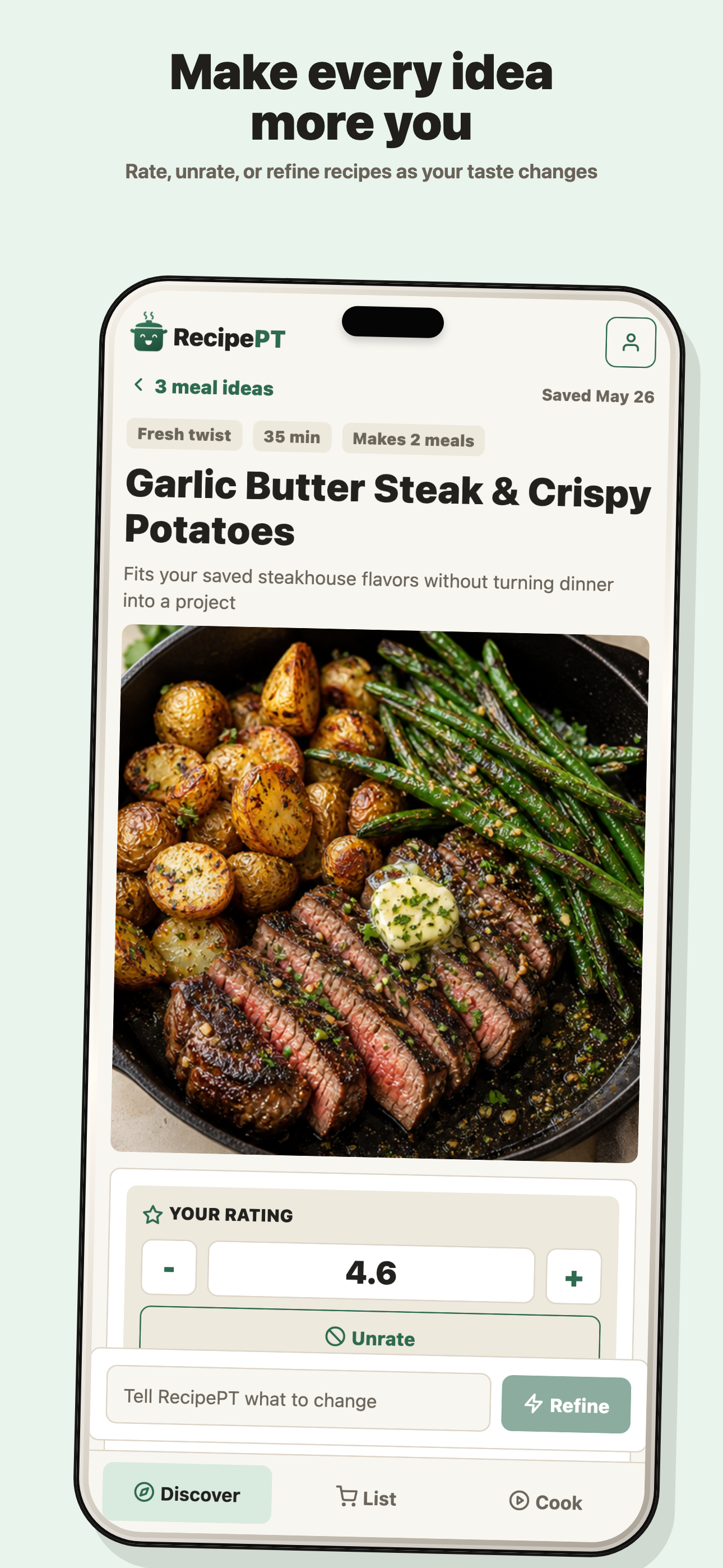
- Asking for plain is a hard override, not a hint. When the request contains picky, plain, simple, basic, nothing weird, or no surprises, a safe-familiar mode outranks the app's own variety goals and applies to every card, first one included. Ideas then come from a recognizable list: crispy chicken, cheeseburgers, cheesy baked pasta, mild tacos, meatloaf, roast chicken with potatoes, breakfast for dinner, mild chili or beef stew. Curries, bean and lentil mains and anything bold or globally inspired are ruled out for that batch unless your own history proves you already cook that lane. The failure it prevents is handing a picky household a chickpea coconut curry as its first idea.
- There is a standing version of it. Onboarding asks how adventurous you are and "Keep it familiar" is one of the answers, adjustable later in Profile. Tonight's typed ask overrides it in both directions, so a cook who usually wants bold food can still ask for plain on a Tuesday.
- Some of it is one tap. Preset asks include "Crowd pleaser for picky eaters," "Something the kids will actually eat," and "Extra veggies without tasting like it," which is the hidden-vegetable path phrased the way parents think about it.
- Tonight's no is not forever. A bare "no onions" is a hard exclusion for that request and then lets go. Permanence takes a permanence word: always, never, from now on, or remember. Which rules are worth keeping is its own decision, and how other apps handle exclusions is in the picky-eater app comparison.
The honest limits. RecipePT does not know your kid. It learns from what you cook and rate, so week one is rougher than week five. It is a paid subscription with a 1-week free trial, cancel anytime. And a saved avoid list is a real filter, but no app should be your only line of defense on a genuine allergy. Read the label.
Common questions
What should I make for dinner with picky eaters tonight?
Make a dinner that comes apart into components. A build-your-own taco or rice bowl night, a sheet pan where nothing is sauced and one corner stays plain, or breakfast for dinner. All three let one person eat the assembled version and another eat three separate piles, without you cooking twice.
Should I cook a separate meal for my picky eater?
Cooking a second dinner is a lot to sustain, which is why the component approach is worth the switch. Serve one dinner that includes at least one item you know they will eat, keep the parts separate, and let them build their own plate from what is on the table.
Is there an app that suggests dinners for picky eaters?
RecipePT, which we make, is built for it: type picky or nothing weird and every idea in the batch becomes recognizable comfort food, and you can add "no onions" to any single idea without saving it as a permanent rule. SuperCook is the strongest free option if you mainly want to exclude ingredients from a search.
Ask for plain and mean it
Say what your table will actually eat, in your own words, and RecipePT holds onto it. Tonight's no applies to tonight. The dinners you cook and rate shape what shows up tomorrow.
Get RecipePT on iPhone