
AI dinner apps
NYT Cooking Is the Best Recipe Library. It Still Doesn't Tell You What to Make Tonight.
Quick answer: Keep NYT Cooking when you want a deep, editor-tested recipe library with trusted instructions, videos, ratings, and useful reader notes. Choose RecipePT when the unfinished job comes earlier: narrow tonight to a few personalized ideas and revise them in plain language. One helps you find a recipe. The other helps you commit to dinner.
Searching for an NYT Cooking alternative can mean “give me another excellent recipe collection,” or it can mean “I already have excellent recipes and still cannot pick one.” Those are different buying jobs. This comparison does not pretend RecipePT has a stronger library. It asks whether a library is the tool you were missing in the first place.
I build RecipePT, so this is a product-positioning comparison from one side of it, not a claim that I completed a hands-on test of every NYT Cooking feature. NYT facts come from the current U.S. App Store listing and Google Play listing, checked October 9, 2026. RecipePT facts come from the current product and its U.S. App Store listing.
What is the best NYT Cooking alternative?
RecipePT is a useful NYT Cooking alternative only when choosing dinner is harder than finding a good recipe. Keep NYT Cooking for tested recipes, editorial curation, videos, ratings, and reader notes. Choose RecipePT for a short personalized set shaped by tonight's request, food rules, and past choices. The jobs overlap less than the category suggests.
- Choose NYT Cooking when recipe quality, instruction, and discovery are the missing pieces.
- Choose RecipePT when plenty of recipes look possible but none has become tonight's plan.
- Choose neither if a short household rotation already makes dinner easy.
Current search results mix editorial recipe sites, cookbook managers, meal planners, and AI generators under the word “alternative.” A longer feature checklist cannot resolve that mixed intent. Start with the output you want at 6 p.m.: a trustworthy recipe to inspect, a collection to organize, a week to schedule, or one dinner direction you can accept or correct.
When is NYT Cooking clearly the better app?
Choose NYT Cooking when you want recipes developed and tested as editorial work, plus curated collections, instructional videos, ratings, reviews, and practical notes from other cooks. Its Recipe Box and grocery tools support repeat use after discovery. RecipePT cannot replace that depth, communal knowledge, or test-kitchen promise and should not claim to.
The strongest NYT Cooking advantage is not the number of recipes. It is confidence in the object you found. Its official app listing says every recipe in the collection is tested, new recipes and videos are published daily, and thousands of home cooks contribute ratings, reviews, and tips. That editorial and community context matters when technique or reliability matters more than personalization.
NYT Cooking also has the better browsing environment. Editor-curated collections can surface a good baking project, holiday centerpiece, or 30-minute dinner without asking you to describe the dish first. If exploring recipes is pleasurable rather than exhausting, a strong library is not a problem to solve. It is the product you should keep.
What problem can a great recipe library leave unfinished?
A library answers “what could I cook?” by making many good recipes searchable and browsable. The nightly question is narrower: “what am I willing to cook now?” Time, cleanup, ingredients, recent meals, household vetoes, and mood can leave dozens of excellent recipes equally plausible. More depth improves options without necessarily producing a commitment.
That is not a criticism of NYT Cooking. Libraries are designed to preserve possibility. Their search, filters, collections, ratings, and Recipe Box help you inspect candidates responsibly. A decider is designed to spend possibility. It should use enough context to present a small answer, then make rejection and correction cheaper than starting another search.
This distinction also explains why an “alternative” can have fewer recipes and still be useful. The product is not competing to contain more knowledge. It is competing to reduce the number of live options. Our guide to AI recipe generators versus dinner deciders goes deeper on that difference.
Does NYT Cooking already help you choose?
Yes. NYT Cooking offers search, editor-curated collections, meal-oriented categories, ratings, reader notes, and a Recipe Box, all of which make choosing easier. The distinction is not help versus no help. NYT guides discovery inside its library. RecipePT starts from the current person and moment, then limits the answer to a few directions.
It would be false to describe NYT Cooking as a passive pile of recipes. Editorial selection is itself a form of decision support, and ratings can quickly separate a proven crowd favorite from a less familiar option. For many cooks, a collection such as easy weeknight dinners is exactly enough narrowing.
RecipePT becomes relevant one step later, when every remaining candidate is still technically fine. It can use declared food rules, current language, saved and cooked recipes, ratings, and recent rejections to shape the small set. If that extra layer would not change your choice, it is unnecessary software.
What does RecipePT's smaller decision surface look like?
A current RecipePT result shows Crispy Hot Honey Salmon Bowl as one candidate, explains that it fits a past rating and the time since salmon, and keeps “Not this” beside a plain-language refinement field. The evidence is visible before commitment, and the next action is reacting to one option rather than searching a catalog.
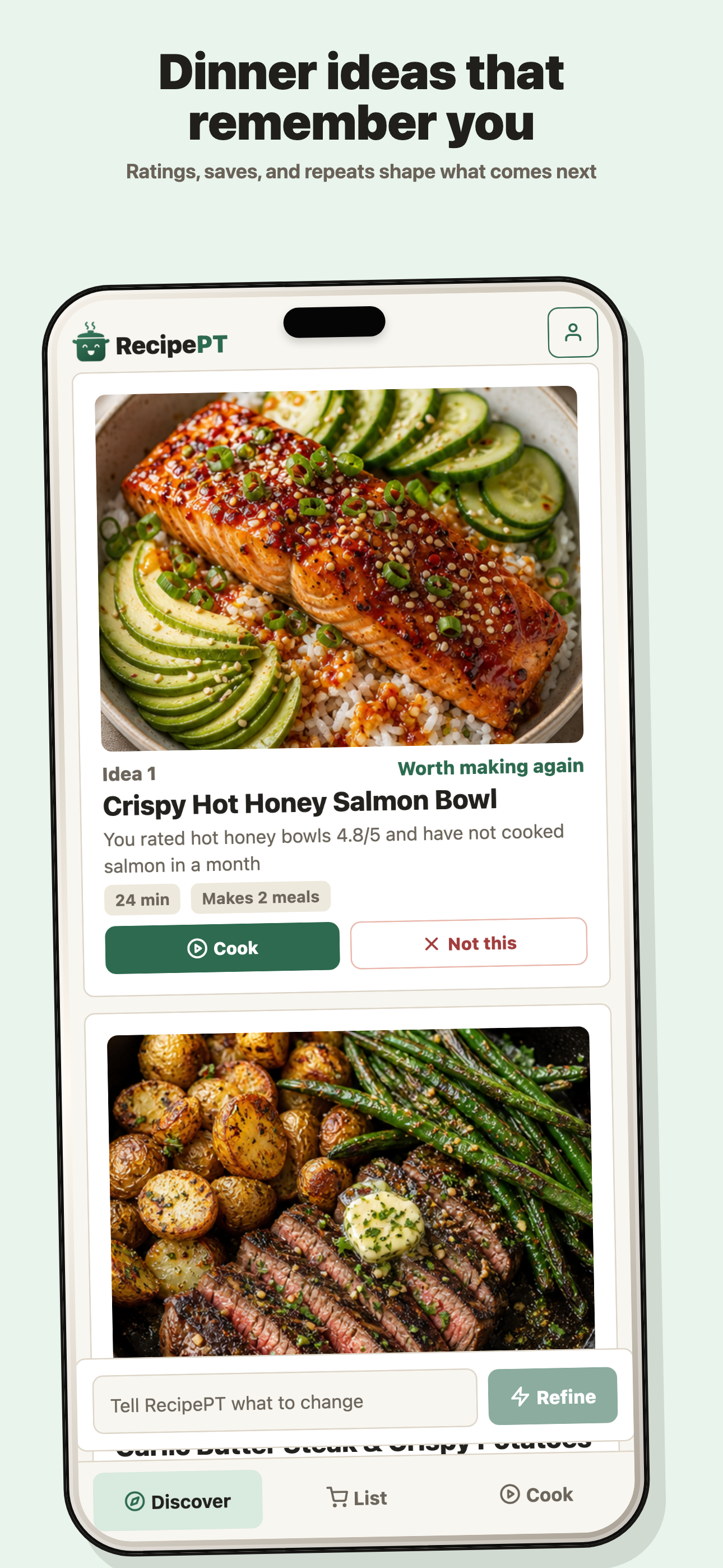
That screen is the first-hand product proof behind this comparison. The useful detail is not the salmon bowl itself. It is the reason attached to it and the cheap correction path. A person can type “less sweet,” “use chicken,” or “faster” without translating the thought into a new set of filters.
The tradeoff is equally concrete. RecipePT's suggestions are generated and adapted for the user. They do not carry NYT Cooking's editorial test-kitchen promise or its large body of public reader notes. The app can estimate recipe and nutrition details, but users still need their own judgment for allergies, food safety, doneness, and dietary needs.
Should you replace NYT Cooking or use both?
Replace NYT Cooking only if you rarely use its editorial library and repeatedly need help choosing tonight. Keep both when tested recipe discovery and personalized decision support are separate, recurring needs. Keep only NYT Cooking when browsing solves dinner. Keep only RecipePT when you already trust other recipe sources and need the final narrowing.
Two subscriptions should finish two different jobs. A sensible pairing is to use RecipePT to identify the kind of dinner that fits, then use NYT Cooking when you want an editorially tested version of that dish. An equally sensible choice is to use NYT Cooking alone and maintain a short favorites list inside its Recipe Box.
Do not add a second app because its features look complementary on paper. Add it only after noticing the same unresolved moment several times. If you repeatedly browse excellent recipes and close the app without choosing, decision support may earn its place. If not, one library is cleaner.
Which product is worth paying for?
NYT Cooking is worth paying for when you use its editorial recipes, testing, collections, and cook knowledge. RecipePT is worth paying for when personalized narrowing and plain-language revision repeatedly save the dinner decision. Since both reserve core value for paid access, price is not the useful dividing line. The repeated job is.
Avoid comparing one introductory offer with another product's standard price. Trials, bundles, and local rates change, while the product shape stays more stable. NYT Cooking's current listings describe a subscription for unlimited recipe access. RecipePT is also a paid product after an eligible one-week trial. Check the store screen before subscribing.
The free alternative to either is a small written rotation. List seven dinners your household already accepts, keep one low-effort fallback, and pick the first option that fits tonight. If that removes the problem, a subscription would automate a habit you already maintain cheaply.
Which app should you choose?
Choose NYT Cooking if your next question is “which recipe can I trust?” Choose RecipePT if it is “which dinner fits me tonight?” NYT Cooking is the stronger library, teacher, and browsing destination. RecipePT is the narrower decider. If your real need is organizing recipes from everywhere, choose a dedicated manager instead of either one.
| Decision | NYT Cooking | RecipePT |
|---|---|---|
| Primary job | Find and cook trusted editorial recipes | Narrow tonight to personalized directions |
| Recipe source | Recipes from NYT editors and contributors | Generated ideas plus imported and saved recipes |
| Quality signal | Testing, ratings, reviews, and reader notes | Fit reasons from current requests and food memory |
| Best interaction | Search, browse, compare, then choose | React, reject, or refine in plain language |
| Platforms | iPhone, iPad, Android, and web | iPhone |
| Honest limit | A deep library can leave the final choice open | No editorial test kitchen or comparable public notes |
The clean verdict is asymmetric because NYT Cooking sets a high bar at its own job. RecipePT should not claim to replace decades of editorial recipe work. It should replace the blank prompt, repeated search, and unresolved shortlist only when those are the parts making dinner hard.
Already have enough recipes?
RecipePT starts with what fits tonight, explains why, and lets you type what should change. It is for the decision before the recipe, not a replacement for NYT Cooking's editorial library. On iPhone. Eligible new subscribers get a 1-week free trial. Cancel anytime.
Get RecipePT on iPhoneWhat else should you know?
Is NYT Cooking worth paying for?
NYT Cooking is worth paying for when you regularly use its tested recipes, editorial collections, videos, Recipe Box, grocery tools, ratings, and reader notes. It is harder to justify if you already trust another recipe source and your real problem is choosing among too many acceptable dinners. Pay for the missing job, not overlapping features.
Is the NYT Cooking app free?
The NYT Cooking app is free to download, but its current U.S. App Store listing says a subscription provides unlimited access to recipes and more. Access can also be included in broader New York Times subscriptions. Check the current offer shown to your account because bundles, trials, and regional pricing can change.
Are RecipePT recipes tested like NYT Cooking recipes?
No. NYT Cooking says every recipe in its collection is tested for accuracy and quality. RecipePT generates and adapts recipes for the user's request, so it is not an editorial test-kitchen library and should not be presented as one. Use your own judgment for food safety, allergies, doneness, and estimated nutrition.
Can I use NYT Cooking and RecipePT together?
Yes. Use NYT Cooking when you want to browse a trusted editorial collection or follow a specific tested recipe. Use RecipePT when you want help choosing a direction from your current craving, food rules, and history. Keeping both makes sense only if those two jobs recur often enough to justify two paid products.