
AI dinner apps
ReciMe vs RecipePT: Saving Recipes From TikTok Is Step One, Then What?
Nobody looks for a ReciMe alternative because the importing broke. The importing is the part that works. People go looking a year in, when the library is two hundred recipes deep, every one of them saved by a version of themselves who was excited about cooking, and 6pm arrives anyway with nothing decided. Here is the honest head-to-head, including the case for keeping ReciMe and not switching at all.
What is a good ReciMe alternative that also helps you decide what to cook?
If you want a better archive, you already have one. ReciMe is excellent at saving and organizing. If the trouble is that the library grew and dinner is still undecided, the alternative is not another archive. It is an app that reads your saves as evidence of taste and opens on an answer. RecipePT does that, and RecipePT is ours.
Everything below about ReciMe was checked against its current App Store listing on August 24, 2026. Feature lists and prices move. The shape of an app moves much more slowly, and the shape is what you are actually choosing between.
Why do people look for a ReciMe alternative?
Usually because the collection outgrew the point of collecting. A saved folder of twenty recipes is a shortlist. Two hundred is a second scroll, and it shows up at the exact moment you have the least patience for scrolling. The archive quietly became another version of the problem it was meant to solve.
It is worth being precise about the failure, because it is not a software bug and no amount of better folders fixes it. Saving is something you do in an optimistic mood. You are on the couch, the video is beautiful, the person in it is calm and has clean hands and forty minutes. Cooking is something you do in a tired one. Those two people have different information and different appetites, and the archive only ever hears from the first one.
So the library fills with aspiration and gets used for nothing. That is the same loop we pulled apart in dinner decision fatigue: having options is not the same as making a choice, and past a certain count, more options make the choice harder rather than easier. Tagging them by cuisine does not change that. It just makes the pile navigable.
What does ReciMe actually do well?
It builds a permanent personal cookbook out of things scattered across the internet, and it does it reliably. Its App Store listing on August 24, 2026 shows a 4.8 average across 278,708 ratings, a free download with a premium tier and a 7-day free trial, and saving from Instagram, Facebook, TikTok, YouTube and Pinterest.
The breadth is real and it is not only social. The listing describes bringing recipes over from Paprika, the Notes app, Google Docs, Notion and Evernote, so a decade of scattered collecting can end up in one place. From there it does cookbooks, ingredient scaling, metric and standard conversion, a cook mode that keeps the screen awake, and cloud sync across iOS and iPad.
Two things it does that are genuinely worth staying for. Nutrition is a full macro breakdown, calories plus protein, carbs and fats, on any recipe. And grocery lists can be sorted by supermarket aisle or by recipe, then turned into an actual delivery ordered inside the app. If you are tracking macros or you shop by delivery, those are load-bearing features, and no amount of better dinner ideas replaces them.
The honest version: if your saved recipes get cooked, do not switch. ReciMe calls itself the number one recipe organizer, and while that is their line rather than an independent finding, 278,708 ratings at a 4.8 average is not what a bad app looks like. This post is about a narrower night: the one where the library is full and you still cannot pick.
ReciMe vs RecipePT: what actually differs?
What the app is for. ReciMe is a library, so it opens on everything you have ever saved and waits. RecipePT is a decision, so it opens on a small set of dinners chosen for tonight, shaped by what you have cooked and rated before, and you steer them by typing in plain language.
| ReciMe | RecipePT | |
|---|---|---|
| What it opens on | Your saved library, organized into cookbooks | Dinner ideas picked for tonight |
| Imports from social | Instagram, Facebook, TikTok, YouTube, Pinterest | TikTok, Instagram, Facebook, Pinterest, YouTube, links, pasted text, photos |
| What your saves are used for | Storage and organization | Storage, plus a taste signal that shapes future picks |
| How you narrow things down | Filters, cookbooks, meal type, cuisine, diet tags | Type it, like "no onions" or "lighter than last night" |
| Nutrition | Full macros: calories, protein, carbs, fats | An estimate of calories per serving |
| Groceries | List by aisle or recipe, plus delivery ordered in-app | List sorted by aisle, built from the dinners you chose |
| Cost | Free download, premium subscription, 7-day free trial | Paid subscription. 1-week free trial. Cancel anytime. |
The row that matters is the third one. In a library, saving a recipe is a filing action and that is the end of it. The app is not any different tomorrow because you saved something today. In RecipePT the save is evidence, and the app is different tomorrow because of it.
What does RecipePT do with a saved recipe that a library does not?
It grades it, then hands it back. A recipe you merely saved is a weak signal, because saving is optimism. One you cooked and rated well is real evidence. The strong ones shape what RecipePT suggests next, and can resurface on their own months later when they fit what you asked for.
This distinction is the entire argument of this post, so here is exactly how it works in the app. Every recipe you cook and rate goes into a memory with its rating, how many times you cooked it, and when you last made it. Those become the strongest input to the next set of ideas. Recipes you saved but never cooked are carried too, but flagged as weak interest rather than proof, and recipes you rated badly go on a list of things to steer away from.
You control that. In Profile there is a setting with two options, "Include unrated saves" and "Cooked and rated only". Leave it on the first and things you bookmarked but never made can still inspire a suggestion. Switch it to the second and RecipePT ignores your aspirational saves completely and listens only to what you have actually cooked. That toggle exists because a library full of food-video ambition is a genuinely unreliable description of what you eat.
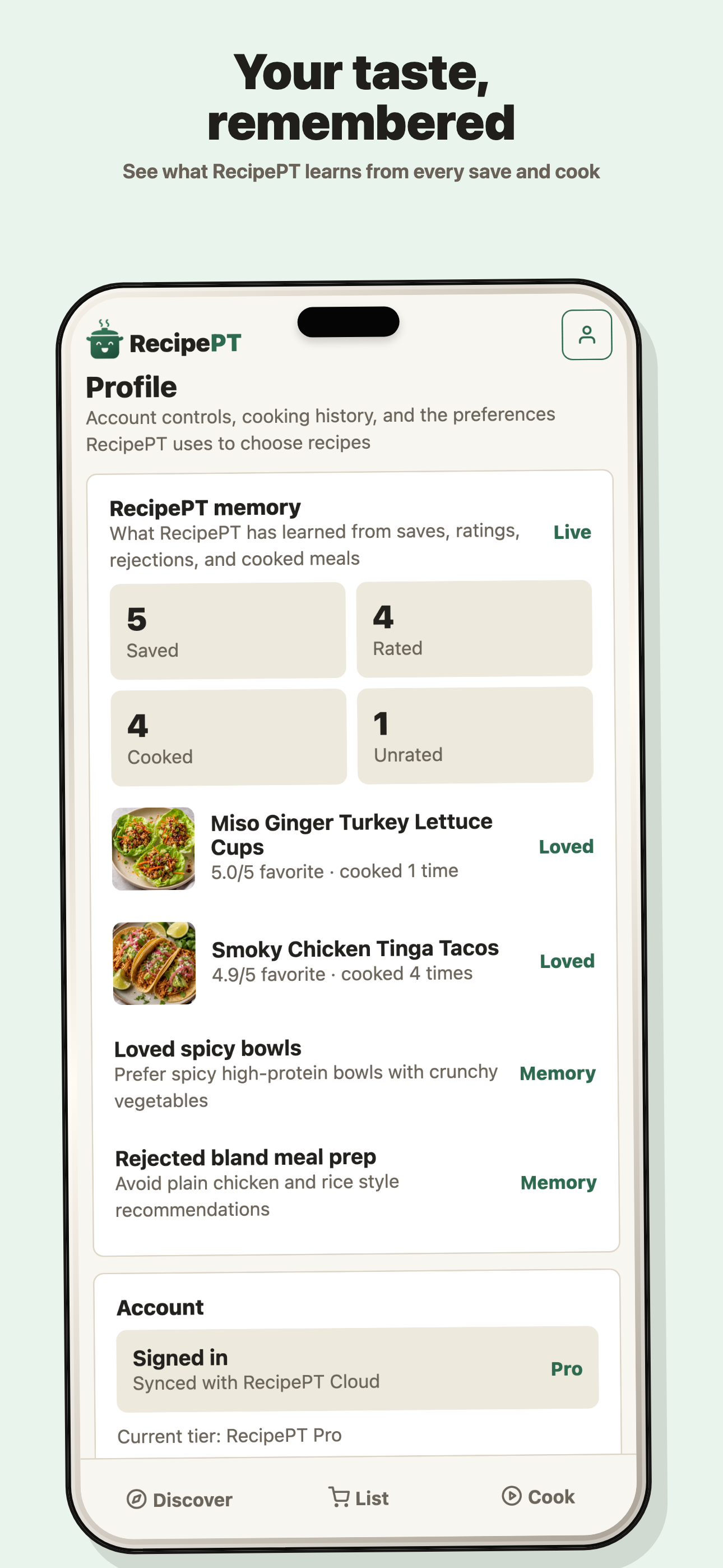
It runs the other way too. RecipePT keeps track of the recent ideas it has shown you and the ones you turned down, so an idea you rejected on Tuesday does not come back on Wednesday wearing a slightly different title. And when you type a constraint, it can be kept for good rather than for the session. Say you have no working oven, or that nobody in the house eats olives, and it becomes a standing rule instead of something you retype nightly. We wrote about which rules are worth keeping in food rules worth remembering.
Which brings us to the answer to "then what". Alongside new ideas, RecipePT can put one of your own saved recipes back in front of you when it fits the night, with the reason attached: you rated this one highly, it has been a while, it is worth making again. A recipe you loved in March is doing nothing for you inside March's folder. The recall line names the rating you gave and how long it has been, which is the difference between an app resurfacing something and an app justifying why.
Importing still matters here, and RecipePT does it: the iOS share sheet, TikTok, Instagram, Facebook, Pinterest, YouTube, links, pasted text, and photos of a cookbook page. The mechanics of that, and where it honestly breaks when a creator only says the recipe out loud, are in the post on importing from Instagram. The point is that importing is table stakes now. What separates these two apps is what happens to the recipe after it lands.
So the verdict is a question about your own saved folder. If you open it, find something and cook it, ReciMe is working and you should keep it. If it has become a place recipes go to be forgotten, more storage will not fix that. These two are not really competing for the same job, which is why "alternative" is a slightly wrong word: one is a filing cabinet with an excellent scanner attached, the other answers a question you have to answer anyway. Pick by which half of the evening goes wrong for you, finding the recipe or deciding on it.
Let RecipePT decide tonight
Your saves and the meals you actually cooked become what RecipePT knows about you, so dinner starts from your taste instead of a blank search box. Type what you want, and it remembers for tomorrow.
Get RecipePT on iPhoneCommon questions
What is a good ReciMe alternative that also helps me decide what to cook?
If you want a better archive, you already have one. ReciMe is genuinely excellent at saving and organizing. If the problem is that the library grew and dinner is still undecided, the alternative is not another archive, it is an app that treats your saves and cooks as evidence of taste and opens on an answer. That is RecipePT, which is ours.
Can RecipePT import recipes from TikTok and Instagram the way ReciMe does?
Yes. RecipePT imports from the iOS share sheet and handles TikTok, Instagram, Facebook, Pinterest, YouTube, web links, pasted text, and photos of a cookbook page or a screenshot. Import quality depends on what the creator actually wrote down. When a recipe is only spoken aloud in a video and never written anywhere, RecipePT says so rather than inventing quantities.
Should I keep using ReciMe?
Keep it if the archive is the point. Its App Store listing describes cookbooks, full macro nutrition covering calories, protein, carbs and fats, grocery lists sorted by aisle or by recipe, and ordering those groceries for delivery inside the app. If you want a permanent, well organized personal cookbook, that is what ReciMe is built to be, and switching away to get a nightly decision means giving those things up.