
What should I cook tonight
What to Cook With What's in the Fridge Right Now: A 3-Step Way to Decide
Quick answer: Don't ask the fridge what you want, because it can't answer that. Ask it what won't keep. Pick the one ingredient closest to the end of its life, pick a cooking format that forgives whatever you're missing, and let the actual recipe be the last decision instead of the first.
Open the door, look at a shelf of perfectly good food, and see nothing that resembles dinner. The ingredients are right there. They just don't announce what they want to be, and the standard move, scrolling for a recipe that happens to match all of them, is a search that almost never lands. Here's the order we run it in, and the order is doing most of the work.
What should I cook with what's in my fridge right now?
Start from what's about to go bad, not from what sounds good. Pick the one ingredient with the least time left and make it the anchor. Then choose a format that tolerates substitutions: skillet, pasta, sheet pan, brothy bowl, eggs for dinner. The recipe comes last, once the shape of the meal is already decided.
The reason "what do I feel like" fails at the fridge door is that you're asking a question your fridge has no information about. It doesn't know your appetite. It knows exactly one thing, which is what's running out of time, and that turns out to be enough to start with. A dinner built on the thing that couldn't wait feels like a decision. A dinner built on a craving your kitchen can't support turns into a grocery trip you weren't planning to make.
This is a different problem from the general 6pm blank page, which we went through in dinner decision fatigue. Here you already have constraints. The trouble is that the constraints arrive as a pile of unrelated items rather than as a meal, and nobody teaches you the sorting step.
Which ingredient should decide dinner?
The one with the least time left that could plausibly carry a meal. Greens, herbs, mushrooms, fresh fish, and anything already opened are on a clock. Rice, pasta, eggs, frozen peas, and canned tomatoes will still be there next week. Choose one anchor per night. Two anchors is two dinners, not one.
Give it sixty seconds and sort what you see into three piles, out loud if that helps:
- On a clock. Bagged greens going limp, herbs, mushrooms, an opened tub of something, cooked chicken from a few nights ago, fish. These get first claim on tonight.
- Fine for now. Root vegetables, hard cheese, eggs, tortillas, the half onion. Useful, not urgent, and mostly what turns an anchor into a meal.
- Always there. Rice, pasta, oil, canned tomatoes, frozen vegetables. These never decide anything. They're the floor under whatever you choose.
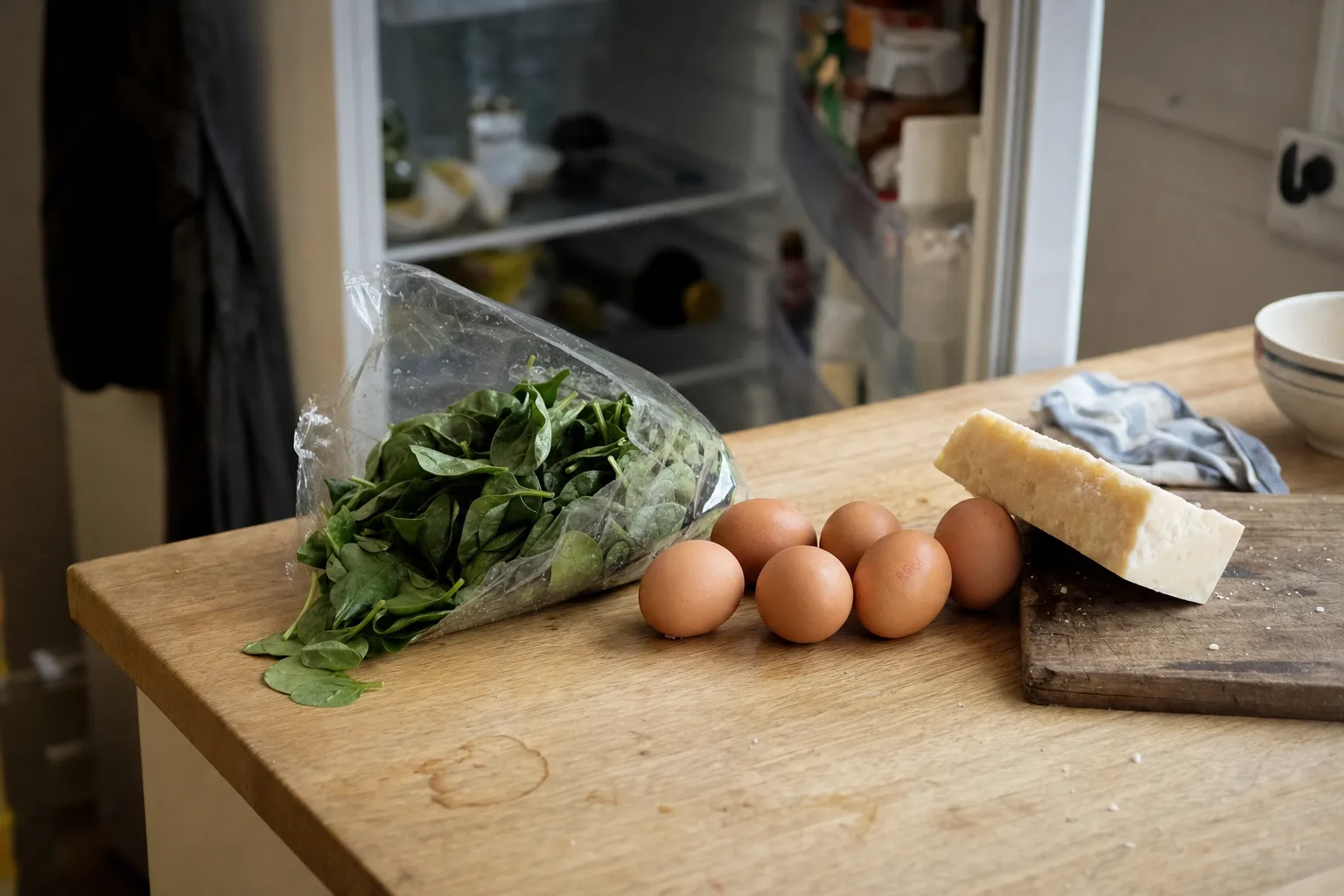
A real fridge from this week: half a bag of spinach, six eggs, a wedge of parmesan, the last of a rotisserie chicken, half an onion, cooked rice in a container. Five of those six items are patient. The spinach is not. So the spinach is the anchor, and the question just got much smaller: what do I make that uses a lot of spinach tonight.
Cooked chicken is the useful edge case here, because it isn't only about spoilage. It has already had the longest step of dinner done to it, so when it's in there it usually wins the night on effort alone, for reasons we've written about separately.
Why should you pick the format before the recipe?
Because a format survives a missing ingredient and a recipe doesn't. A skillet dinner still works if you have no lemon. A specific recipe titled around that lemon does not. Choose the shape of the meal by how much energy you have left, then pour the anchor into it and improvise the details.
Five formats cover nearly every weeknight, and each one forgives something different:
- Eggs for dinner. Lowest effort in the house. Absorbs greens, leftover starch, any cheese. If you're running on empty, stop reading and do this one.
- Skillet. Fat, an aromatic, the anchor, then something sharp at the end. One pan, about fifteen minutes of standing up, tolerates almost any swap.
- Pasta. The most forgiving of all, because the sauce is just your anchor plus fat and cheese. Reliable when the fridge is thin and the pantry isn't.
- Sheet pan. Buys you twenty five minutes off your feet in exchange for a preheat. Worth it when you're tired but not urgently hungry.
- Brothy bowl. The rescue format for a sad vegetable drawer, since simmering hides a multitude of textures that have seen better days.
Pick by energy, not by interest. The single most common way weeknight dinner goes wrong is choosing a format that the 6pm version of you can't pay for. If you're still stalling after this, the 3-question method is a shorter commitment rule.
Back to the spinach. Anchor is spinach, energy is low, so the format is eggs. Wilt the spinach in a pan, add the eggs, parmesan over the top, the cold rice underneath if you want it to be filling. No recipe was ever consulted, and the thing that was going to be thrown out on Saturday is now dinner.
What if there's no dinner in there at all?
Then stop looking. A fridge with no anchor is a shopping problem, not a decision problem, and staring at it longer has never produced a protein. Cook the fallback you named in advance, eat it without ceremony, and put one anchor in tomorrow's cart. This is a legitimate outcome, not a failure of the method.
Two things go wrong at this step, and they're worth telling apart. The first is a genuinely empty fridge, which no app and no method can fix. The second is a fridge with an anchor you don't want to eat, which feels identical and isn't. If you're avoiding the fish, the honest move is to admit it and cook something else, then use or freeze the fish tomorrow. Pretending the choice is missing when it's actually being refused is how people end up ordering delivery at 7:30 with a full refrigerator.
Naming a fallback ahead of time is what makes the empty-fridge night survivable. Pick it while you're calm and fed, not while you're hungry and annoyed, which is part of the same decide-once idea.
How does RecipePT build dinner around what's already in the fridge?
You type what's in there in the words you'd say out loud, and it comes back with dinners built around those items instead of a list of what you're missing. Your allergies and the taste it has learned are applied before you read anything, so the ideas arrive already filtered for your household.
The input box on the Discover tab asks "What are you in the mood for?", and one of the example lines that rotates through it is literally "Use up the spinach and eggs in my fridge". That's in the app because it's the most common way people actually arrive: not with a craving, with an inventory. Type it and you get complete dinners built on those two things, not a grid of matches ranked by how much you're missing.
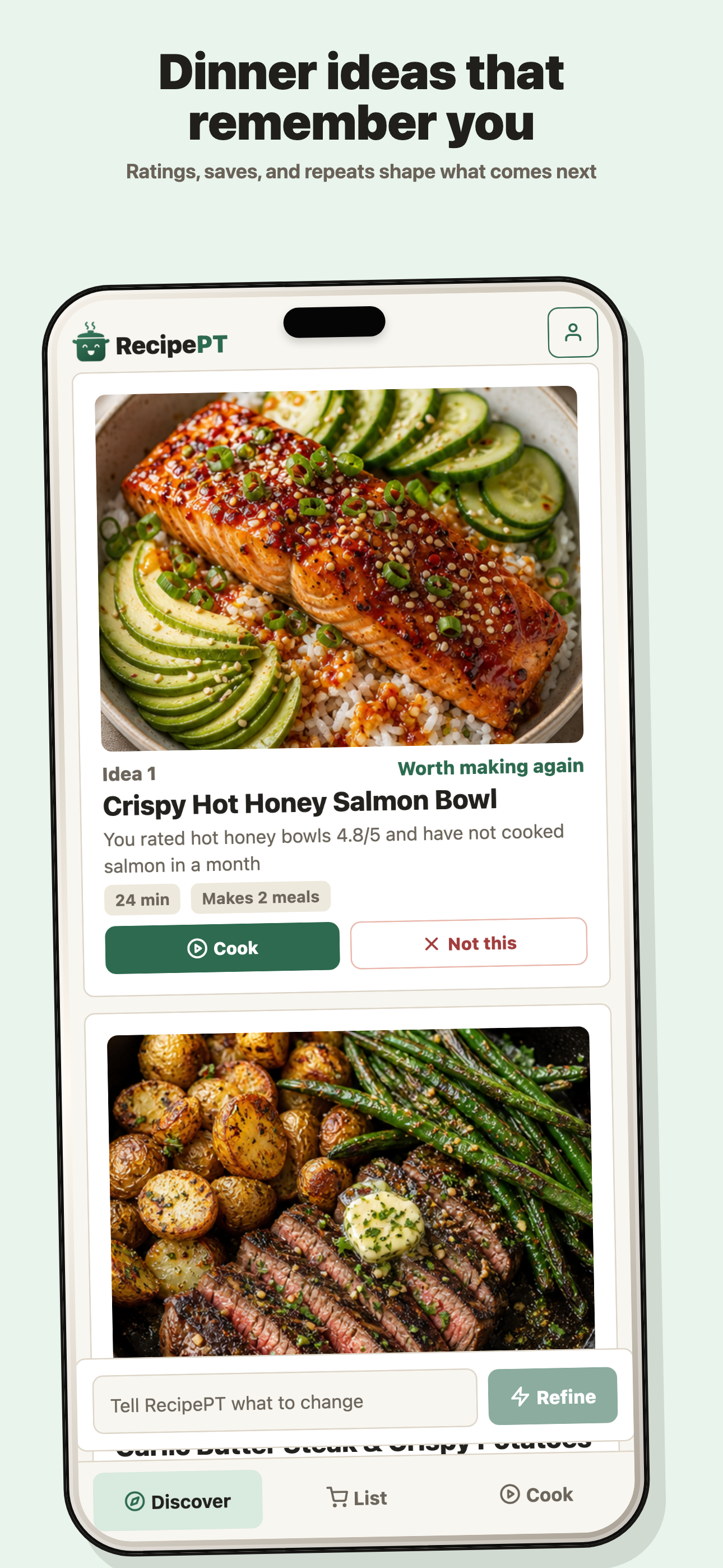
If the first set isn't it, you point the next one. There's a text field for plain language and one-tap directions for the common ones: Lighter, Less prep, Cheaper, Higher protein, More veg, Fresher. What you type wins over what the app has learned about you, on purpose, because the fridge changes faster than your taste does. Say "use the mushrooms too" and it will, even if mushrooms have never once appeared in anything you rated.
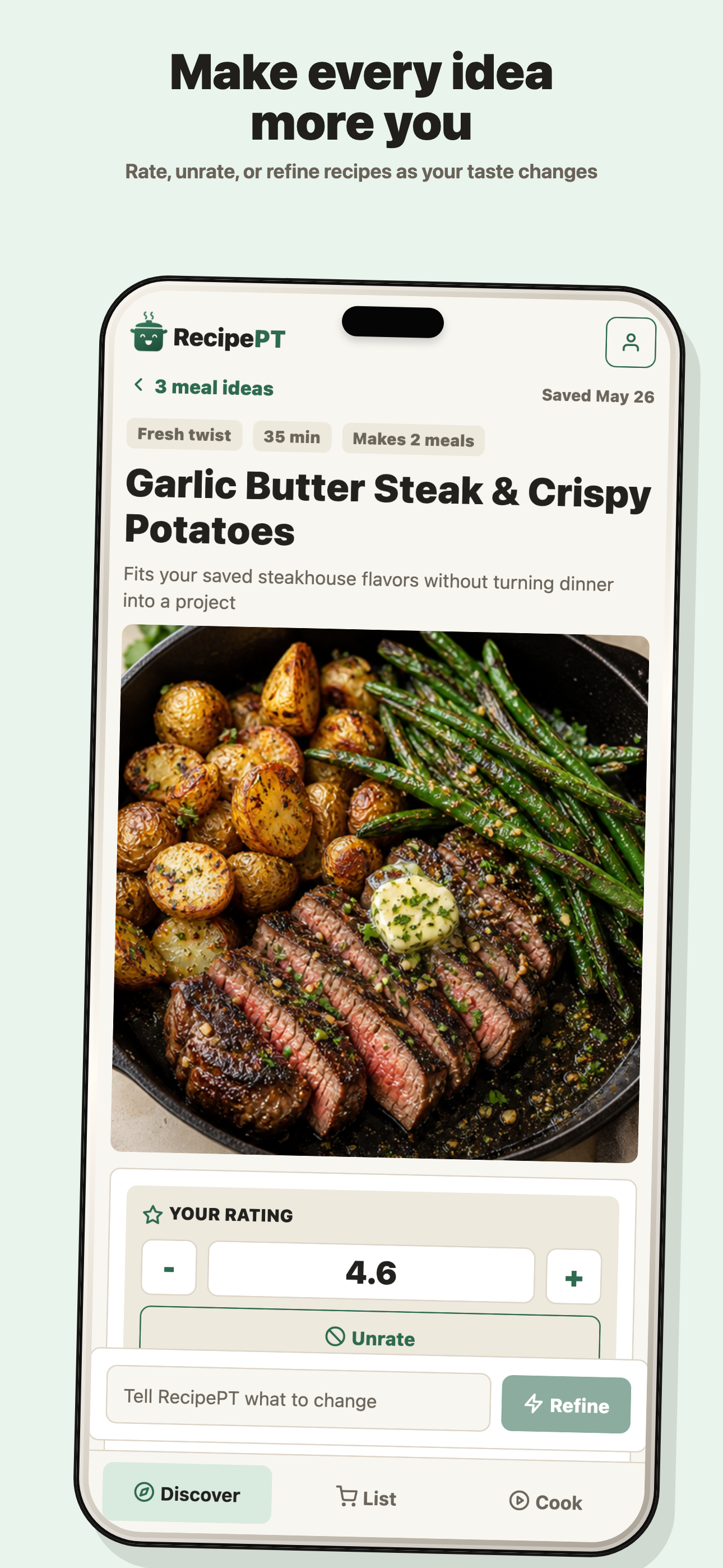
Because those instructions stack up over a session, there's a sheet called "What we know so far" that shows everything currently being applied, with an Undo last if a direction took things somewhere you didn't want. It's there so you never have to guess why an idea showed up.
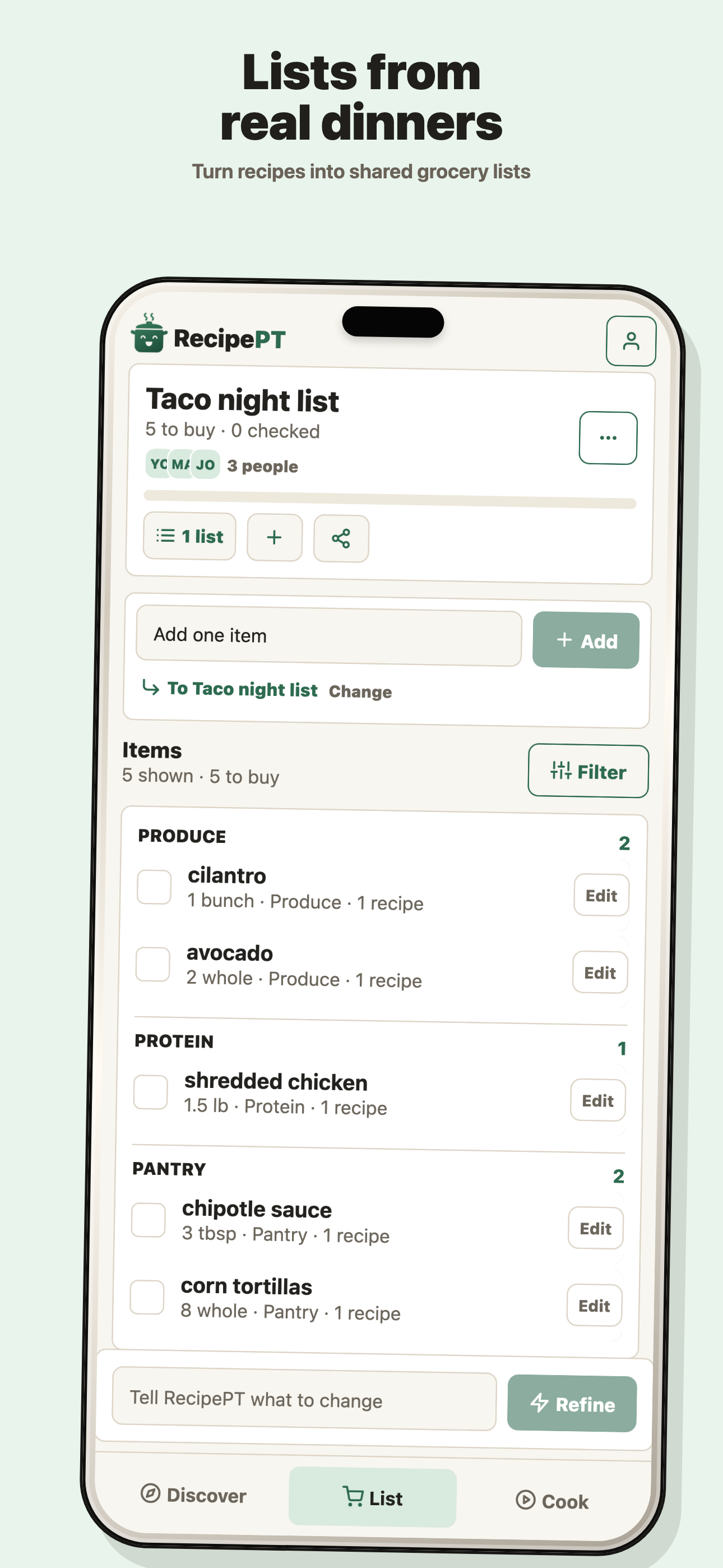
Once you pick one, the two or three things you're actually short of go onto a grocery list sorted by aisle, so a fridge-clearing dinner that needs one lemon doesn't become a second decision.
The honest limit: the app can't see inside your fridge. Nothing can, short of you telling it. What it removes is the second half of the job, turning a pile of items into a meal that suits the people eating it, which is the part that takes the energy you don't have at 6pm.
Tell it what needs using
Say what's in the fridge and what you can't eat. RecipePT builds dinner around it, remembers what your household actually goes for, and gets closer every time you cook. On iPhone.
Get RecipePT on iPhoneCommon questions
What should I cook with what I have in my fridge?
Find the ingredient with the least time left that could plausibly carry a meal, and build around that one thing. Then pick a cooking format rather than a recipe: skillet, pasta, sheet pan, brothy bowl, or eggs for dinner. Formats tolerate missing ingredients, and specific recipes do not.
How do I know which ingredient should decide dinner?
Sort by shelf life, not by preference. Fresh greens, herbs, mushrooms, and anything already opened are on a clock. Rice, pasta, eggs, frozen vegetables, and canned tomatoes will still be there next week, so they're support rather than the anchor. Choose one anchor per night.
Is there an app that tells you what to cook with what you have?
Yes, and they work in two different ways. Ingredient-search apps such as SuperCook match your items against a recipe database and return everything that fits, which is thorough but leaves the choosing to you. RecipePT instead returns a small set of dinners built around what you named, filtered by your allergies and taste.
What should I cook when the fridge is nearly empty?
Stop searching and cook the fallback you named in advance: eggs and toast, pasta with garlic and oil, beans and rice. An empty fridge is a shopping problem, not a decision problem, and no amount of scrolling will put a protein in it. Add one anchor to tomorrow's list.