
What should I cook tonight
Too Tired to Decide on Dinner? Here Are 3 Picks by Exactly How Wiped You Feel
Quick answer: When you are too tired to cook, choose by the next action you can manage. Can you open packages? Assemble a ready-to-eat dinner. Can you press Start? Use a microwave shortcut. Can you wash one pan? Make a single-vessel meal. Take the first workable pick in your lane, and let dinner be simple tonight.
A short recipe can still ask too much. Chopping, checking several pans, and washing up are different kinds of effort. Choose your lane by the physical action you can tolerate before you choose a dish. These are dinner formats, not tested recipes or promises about exact cook times.
What should I make for dinner when I am too tired to cook?
Start with your remaining energy, not an ingredient search. If opening packages is enough, assemble hummus and pita, a chicken wrap, or a bean and cheese plate. If pressing Start is manageable, use a ready meal, soup, or rice with beans. If one pan is fine, choose a quesadilla, gnocchi, or chickpea skillet.
The nine choices below are grouped by the action they demand. Read only your lane. If even the first option sounds exhausting, use food that is already safe to eat or ask somebody else for help. Dinner does not have to be a project to count.
What can I make if I can only open packages?
Choose one of three no-cook plates: hummus with pita and ready-to-eat vegetables, rotisserie chicken rolled into a tortilla with bagged greens, or canned beans with cheese and crackers. All three begin with food that can be eaten without cooking. Pick the one that needs the fewest packages opened in your kitchen.
- Hummus, pita, and vegetables. Put store-washed vegetables or a ready salad beside hummus and pita. Add a boiled egg only if it is already cooked and properly stored.
- Rotisserie chicken wrap. Use cooked chicken, a tortilla, bagged greens, and a sauce already open. Skip the chicken if its storage history is uncertain.
- Bean and cheese plate. Drain canned beans and add cheese, crackers, and a piece of fruit or ready-to-eat vegetables. Season with salsa if you have it.
The decision rule is deliberately blunt: choose the plate with the fewest steps between the food and your mouth. This lane does not require a pan, knife, or new shopping trip.
What can I make if I can press Start on a microwave?
Use food that is already cooked or packaged for microwave preparation. Pair a frozen meal with bagged salad, heat canned soup and eat it with toast, or combine microwave rice with canned beans and salsa. Follow the package instructions, including standing time. Choose the option whose container and ingredients require the least handling.
- Frozen meal plus salad. Follow the label and put a handful of bagged greens on the side. The meal handles the cooking decision.
- Canned soup plus toast. Heat soup in a microwave-safe bowl according to its label. Bread or crackers make it more substantial.
- Rice, beans, and salsa. Heat a microwave rice pouch as directed, add drained canned beans, and heat the combination until hot. Finish with salsa or cheese.
For previously cooked leftovers, storage and reheating matter. The USDA leftovers guide says to refrigerate leftovers promptly, keep refrigerated leftovers for three to four days, and reheat them to 165°F. If you cannot establish how a leftover was stored, use a shelf-stable or frozen option instead.
What can I make if I can wash one pan?
Choose a familiar single-pan format, not a new recipe with hidden prep. Make an egg and cheese quesadilla, warm shelf-stable gnocchi in jarred sauce with spinach, or simmer canned chickpeas with canned tomatoes. Use the dish whose ingredients are already on hand. One pan is the upper limit, so skip anything that needs a separate side.
- Egg and cheese quesadilla. Cook the egg fully using the method you know, add cheese and a tortilla, and finish in the same pan. Use a trusted recipe if this combination is new to you.
- Gnocchi, sauce, and spinach. Use shelf-stable gnocchi and follow its package directions. A suitable pan method may let the sauce and spinach share the vessel.
- Chickpea and tomato skillet. Drain canned chickpeas and warm them with canned tomatoes and a seasoning you already like. Eat with bread if it is available.
This lane assumes the cooking method is already familiar. A recipe labeled easy can still be demanding if you have to learn a technique, thaw food, or clean three tools. Read the instructions before you commit.
How do I choose among three dinners without another decision spiral?
First remove every option above your energy level. Within the remaining lane, choose the first dinner that uses food you already have and sounds acceptable. Do not compare all nine. If two remain, choose the one with fewer dishes. If none fit, move down an energy level or use a ready-made fallback.
The time-based dinner guide starts with the clock. This one starts with the action you can manage. You can have thirty minutes and still be unable to chop; a fifteen-minute recipe is not automatically a low-energy recipe. The two-minute decision method helps when energy is available but commitment is the problem.
What if I have almost no food that fits my energy level?
Check for one ready-to-eat anchor before inventing a dish: bread, crackers, canned beans, a frozen meal, or cooked food with a known storage history. Pair it with anything already edible. If there is no safe, workable option, ordering, asking for help, or buying a prepared meal may be the sensible dinner decision.
The fridge guide helps when you have ingredients but cannot see a meal in them. Here the effort budget comes first. Do not turn a sparse pantry into a complicated scavenger hunt just to avoid a simple fallback.
How can RecipePT help when I have no energy to browse recipes?
RecipePT shows a small set of dinner ideas instead of a long feed. You can describe tonight as “low effort” or “no cook,” then reject an idea or ask for a simpler version in plain language. The current generation instructions treat effort and time limits as constraints on steps and minutes, but you should still inspect the proposed recipe.
This is a product-specific distinction you can check. The real app screen below shows three dinner cards, including a named Crispy Hot Honey Salmon Bowl with a visible 24-minute estimate and Cook and Not this actions. That salmon dish is an example of the interface, not a claim that it belongs in tonight's lowest-energy lane. The app can be told the actual limit before generating ideas.
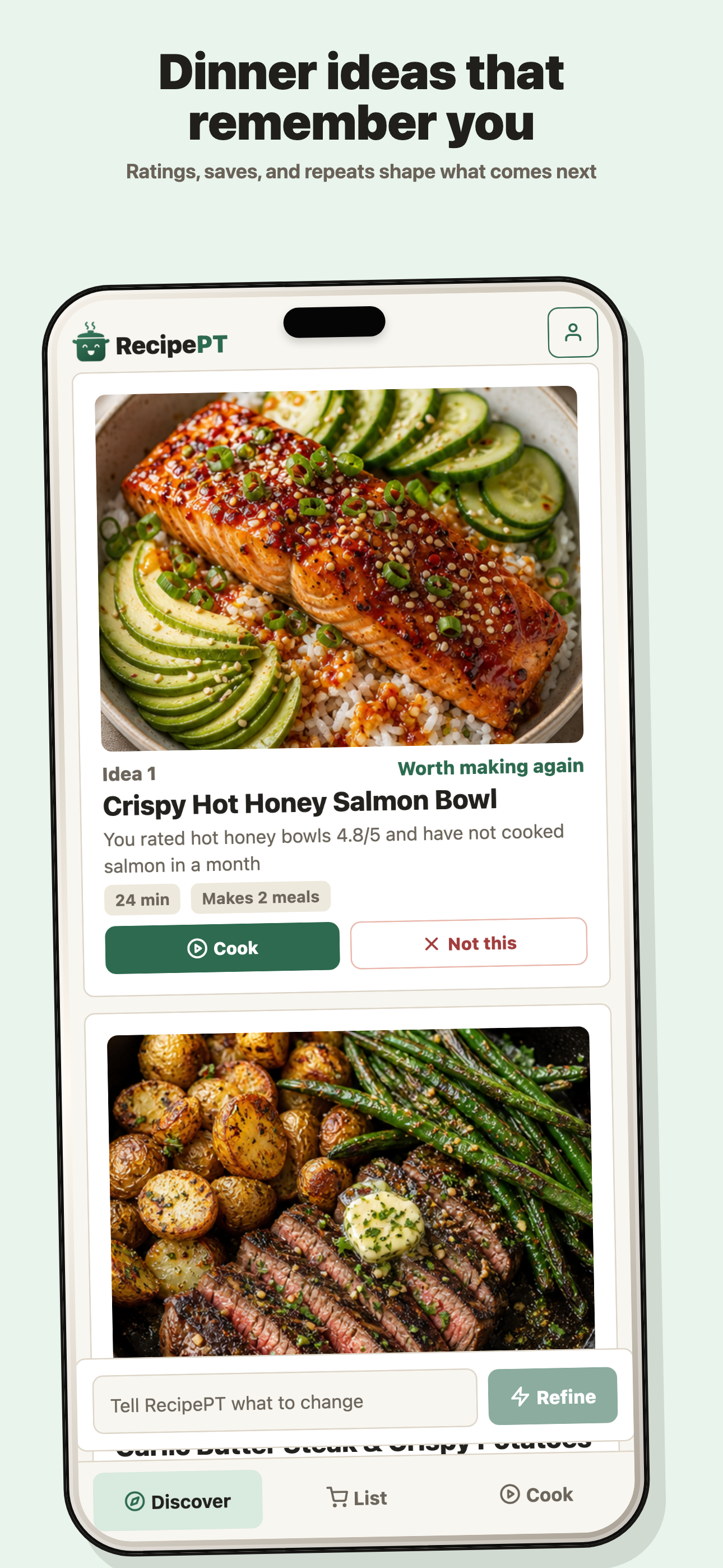
The app's current food-rule memory and refinement flow can help preserve preferences when you ask for less work tonight. The result is still a suggestion to review, not a tested guarantee of preparation time.
When is a ready-made meal the best answer?
Choose a ready-made meal when every home option would demand more energy than you have, or when the ingredients on hand cannot make a safe dinner. A frozen entrée, prepared sandwich, or takeout can close the decision without turning the evening into a test of willpower. Pick one and stop reopening the question.
A good dinner decision respects the cook as well as the food. If this is a repeated pattern, the dinner decision fatigue guide helps change the nightly system. Tonight, make the smallest workable choice.
Want three dinner ideas that respect tonight's energy?
RecipePT is a paid iPhone app that turns your food rules and tonight's request into a small set of ideas. Tell it you need low effort or no cooking, inspect the steps, and refine or reject what does not fit. It begins with a one-week trial, and you can cancel anytime.
What else should I know about low-energy dinners?
Start with what you can physically do, then choose food that is already close to ready. A no-cook plate is valid dinner. A microwave shortcut is useful when its label is clear. A one-pan idea works when the method is familiar. These answers cover the common decisions that can still slow you down.
What can I eat when I am too tired to cook?
If you cannot face heat or cleanup, make a no-cook plate from ready-to-eat food: hummus with pita and vegetables, rotisserie chicken in a wrap, or canned beans with crackers and cheese. Choose the first one whose ingredients are already in reach. A simple assembled meal is a complete dinner decision.
What if I only have the energy to use a microwave?
Use a microwave-safe bowl or plate and start with food that is already cooked: a frozen meal with a bagged salad, canned soup with toast, or a microwave rice pouch with canned beans and salsa. Follow package directions. If reheating leftovers, heat them thoroughly and check the USDA guidance linked above.
How do I choose a low-effort dinner without scrolling?
Ask one question: what kitchen action can I tolerate? If the answer is opening packages, assemble. If it is pressing Start, use the microwave. If washing one vessel is fine, use a single pan. Pick the first dinner in that lane that uses food you already have, and stop searching.
Can RecipePT suggest a dinner with very little cooking?
You can ask RecipePT for a low-effort, easy, or no-cook dinner in plain language. Its current generation instructions treat those limits as constraints on time and steps. It returns a small set of ideas you can reject or refine. Check the actual recipe steps before committing, because a suggestion is not a cooking test.