
What should I cook tonight
Decide Dinner by How Much Time You Have: 15, 30, or 45 Minutes (3 Picks Each)
Quick answer: Start with the time left until you need food on the table, not a recipe's headline. With 15 minutes, assemble or use one fast pan. With 30, cook one shortcut meal. With 45, use the oven or add one from-scratch component. Pick one lane, then the first dinner whose ingredients are already closest to ready.
Thirty minutes is not a cuisine, a craving, or a recipe. It is a boundary. That makes it more useful than asking what sounds good, because a clock can remove choices before you have to compare them. The important part is using the real clock in your kitchen, including the boring minutes a recipe title tends to ignore.
What should I make for dinner if I have only 30 minutes?
Make tomato pasta with white beans and spinach, fried rice from cooked rice, or a chickpea tomato skillet with toast. Those are three different starting states: dry pasta, a cooked leftover, or cans. Choose the one that asks the least preparation from the ingredients sitting in your kitchen right now.
The current search results mostly answer this question with long recipe galleries. That is useful when you are collecting recipes on a Sunday and almost useless when the clock is already running. The faster move is to choose by starting state. Cooked rice wants the frying pan. Pasta and a jar of sauce want the pot. Cans want the skillet.
This is not a promise that every version of those dishes fits every kitchen. A first-time recipe, a slow stove, a missing can opener, or vegetables that still need washing can move the finish line. Read the method you plan to use and choose the version you already understand. The dinner idea is the lane. Your actual recipe is the route.
Why should the dinner clock start before I cook?
Because your available time starts now, while many recipe estimates start after ingredients are found, washed, and measured. Count the whole trip from standing up to putting food on a plate. Then leave a small margin. A 30-minute night needs a familiar dinner with no hidden thaw, marinade, or shopping stop.
Open the recipe and scan every verb before committing. If the first paragraph quietly asks for cooked rice, softened butter, or a preheated oven, that preparation belongs on your clock. If you have never used the technique, the learning belongs there too. The phrase "30-minute dinner" is only helpful after you decide which thirty minutes it is counting.
Also decide what "done" means tonight. If dinner has to be plated by 6:30, use now-to-plate time. If you can put a tray in the oven at 6:30 and wait, active time may matter more. This post uses now-to-plate because that is the stricter and more useful boundary when somebody is already hungry.
What can I make for dinner in 15 minutes?
Choose black bean quesadillas with bagged salad, rotisserie chicken wraps, or eggs on toast with a quick vegetable. Fifteen minutes favors ingredients that are already safe to eat or need one short pan. Pick the cooked protein first, use one familiar flavor, and refuse any plan that begins with thawing.
- Black bean quesadillas with bagged salad. Drain the beans, add cheese and whatever salsa or hot sauce is already open, then crisp the tortillas in a pan. Choose this when you want hot and crunchy without handling raw ingredients.
- Rotisserie chicken wraps. Add bagged slaw or salad, a sauce, and the chicken to a tortilla or pita. Choose this when even washing a pan sounds like the wrong use of the last fifteen minutes.
- Eggs on toast with a quick vegetable. Cook the eggs the way you already know, toast the bread, and add sliced tomato, cucumber, or dressed greens. Choose this when the fridge is sparse but breakfast-for-dinner still feels like dinner.
The fifteen-minute lane is deliberately narrow. It works by giving up scratch cooking, not by moving faster. If all three are impossible because nothing is cooked, the honest choice may be a freezer fallback or ordering food. That is still a decision, and it is better than losing fifteen minutes to a plan you cannot finish.
What can I make for dinner in 30 minutes?
Pick tomato pasta with white beans and spinach, fried rice with egg and frozen vegetables, or a chickpea tomato skillet with toast. Pasta works from a stocked cupboard, fried rice rescues a cooked grain, and the skillet needs no grain at all. Let the ingredient already nearest to dinner choose for you.
- Tomato pasta with white beans and spinach. Put the pasta water on first. Warm jarred tomato sauce with drained beans, wilt in spinach, then combine. Choose this when dry pasta is the most ready substantial thing in the house.
- Fried rice with egg and frozen vegetables. This lane assumes the rice is already cooked. Use the widest pan you have, cook the egg and vegetables, add the rice, then season with a sauce you already trust. Choose it when last night's grain needs using.
- Chickpea tomato skillet with toast. Soften whatever aromatic you use, add canned chickpeas and tomatoes, and simmer while bread toasts. Choose this when the cupboard is stronger than the fridge and you want something spoonable and warm.
These are dinner formats, not complete recipes. Your sauce, pan, ingredient sizes, and heat determine the actual timing. That distinction matters because a useful idea should point you toward a recipe you know, not pretend three sentences can replace tested instructions. If random ingredients are the real constraint, use the three-step fridge method before choosing a time lane.
For the fried rice, use rice that was refrigerated promptly and reheat it thoroughly. The USDA leftovers guidance says cooked leftovers should be refrigerated within two hours and reheated to 165°F. If you do not know how the rice was stored, choose the pasta or chickpea skillet instead.
What can I make for dinner in 45 minutes?
Choose a familiar sheet-pan sausage dinner with peppers and small-cut potatoes, baked pasta with greens, or coconut chickpea curry with rice. Forty-five minutes buys one longer oven or simmering step, not unlimited complexity. Pick the dish whose waiting time can happen while you prepare the rest.
- Sheet-pan sausage, peppers, and small-cut potatoes. Use a recipe you already trust, cut the potatoes small enough for that recipe's timing, and check the sausage package for handling and doneness instructions. Choose this when you want the oven doing most of the work.
- Baked pasta with greens. Boil the pasta while the oven heats, combine it with sauce, greens, and cheese, then bake until the recipe says it is ready. Choose this when comfort matters and leftovers tomorrow would be useful.
- Coconut chickpea curry with rice. Start the rice first, then build the chickpea curry while it cooks. Choose this when you want a from-scratch sauce but still need two parts of dinner to run at the same time.
Parallel steps are the reason these fit the bracket. The moment a plan asks you to finish one long task before starting the next, forty-five minutes disappears. This is the lane for one unattended wait and one active job, not for three ambitious components.
How do I choose one dinner inside my time bracket?
Look for the ingredient closest to ready. A cooked leftover beats a raw ingredient, a can beats a dry bean, and a familiar method beats a new one. Then take the first dinner that fits the clock and sounds acceptable. The bracket removes options; the starting state breaks the final tie.
This is different from the one-non-negotiable method in how to decide dinner in under two minutes. There, you already have a shortlist and need to commit. Here, the physical state of the food does the narrowing before a shortlist exists. The ingredient with the least distance left to travel becomes the anchor.
If two options remain, choose the one that uses the fewer fragile assumptions. Cooked rice plus frozen vegetables is a better thirty-minute bet than raw chicken you still need to thaw. A familiar pasta is a better bet than a faster-looking recipe with a technique you have never tried. Reliability is part of speed.
How do I stop a quick dinner from taking an hour?
Choose a familiar method, use ingredients in their current state, and avoid two waiting steps in sequence. Read the recipe before starting. If anything needs thawing, marinating, or a special store trip, it does not fit tonight's bracket. Drop to the faster lane instead of hoping the clock will stretch.
The common trap is starting with the desired dish and negotiating with time afterward. Reverse it. Fifteen, thirty, and forty-five minutes are different kitchens. The fifteen-minute kitchen contains cooked and canned food. The thirty-minute kitchen adds one real cooking process. The forty-five-minute kitchen adds an oven or a simmer. Do not move a forty-five-minute idea into the thirty-minute kitchen by writing "quick" in front of it.
When the answer is still no because everything sounds like work, stop treating it as a recipe problem. The post on why you cannot decide what to eat uses a candidate and your reaction to it, while the guide for dinner with one picky eater chooses by the kind of refusal you are dealing with.
How does RecipePT use a time limit without giving me another list?
RecipePT shows a small set of personalized dinner ideas with total-minute estimates on the cards. You can also ask in plain language for "high protein, under 30 minutes" or "fifteen minutes, tops." Choose the card inside tonight's lane, or refine one to make it quicker without starting a new search.
Those quoted prompts are real options in the current app, not invented examples. The screen below is also a real RecipePT screen: the first idea is a Crispy Hot Honey Salmon Bowl labeled 24 minutes, with a reason tied to previous ratings and cooking history. The time is visible before you open the recipe, alongside Cook and Not this.
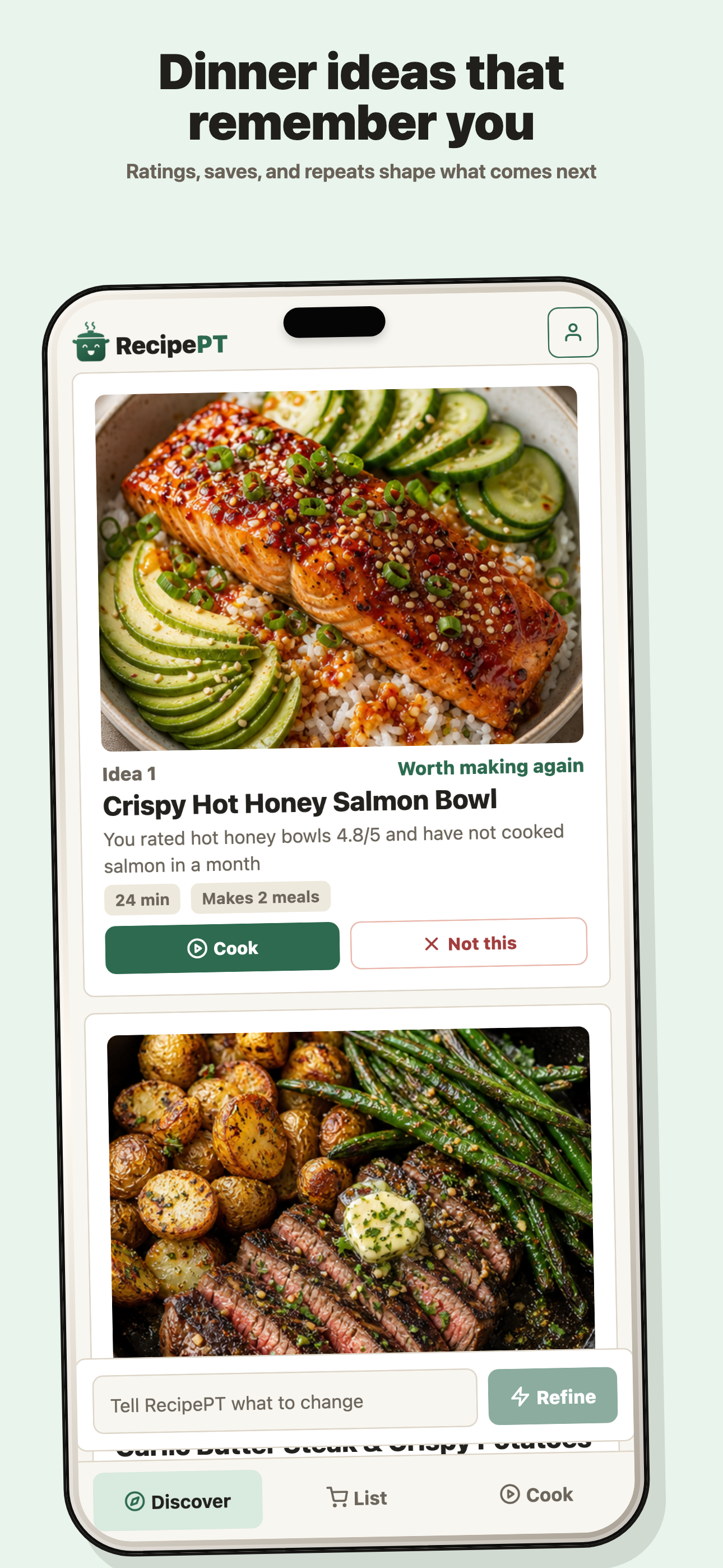
Time is only one constraint, so it should not erase taste. RecipePT uses the same food rules, ratings, saves, repeats, and avoids that shape the rest of its dinner suggestions. If the card is close but the method is too involved tonight, a request such as "make it quicker" is treated as a tweak to the open recipe. "Not this" asks for a genuinely different dish. That distinction keeps the clock useful without turning every short night into the same dinner.
Want RecipePT to keep tonight inside the clock?
RecipePT is a paid iPhone app for turning your taste, food rules, and tonight's constraint into a small decision. Ask for the time you actually have, see the estimate before cooking, and refine the idea in plain language. It begins with a one-week trial, and you can cancel anytime.
What else should I know about time-limited dinners?
Treat the bracket as a boundary, not a guarantee. Count prep, choose a method you know, and use the ingredients in front of you rather than an imaginary stocked kitchen. The answers below clarify the most common timing traps so a quick dinner stays quick after you leave this page.
What can I make for dinner in 30 minutes?
Pick tomato pasta with white beans and spinach, fried rice made with cooked rice, or a chickpea tomato skillet with toast. Pasta suits a stocked cupboard, fried rice uses leftovers, and the skillet works without a cooked grain. Choose the one whose starting ingredients are already closest to ready.
Does a 30-minute dinner include prep time?
It should if 30 minutes is the time you truly have. Count preheating, chopping, finding ingredients, and bringing water to a boil. Recipe labels vary, so read the method before trusting the headline. This guide treats the budget as now-to-plate time and favors familiar methods with a little margin.
What should I make when I only have 15 minutes?
Choose an assembly meal or one fast pan: black bean quesadillas with bagged salad, rotisserie chicken wraps, or eggs on toast with a quick vegetable. Do not spend the first five minutes browsing. Pick according to what is already cooked, then use one sauce or seasoning you know you like.
How do I make sure a quick dinner stays quick?
Choose a familiar method, use ingredients in the state they are in, and avoid two waiting steps in sequence. Read the whole recipe before starting. If something needs thawing, marinating, or a specialty trip, it does not belong in tonight's bracket. Drop down one lane instead of hoping the clock will stretch.
Find something good for dinner.
Browse recipes, search an ingredient, and pick something that fits tonight.
Browse recipes →